
Since 2018, the project Social, Environmental, and Economic Co-Benefits of Energy Efficiency and Renewable Energies in Mexico has been implemented through the project Enhancing the Coherence of Climate and Energy Policies in Mexico (CONECC) of the Deutsche Gesellschaft für Internationale Zusammenarbeit (GIZ) GmbH (German Cooperation for Sustainable Development), in coordination with the Ministry of Environment and Natural Resources (SEMARNAT) and in collaboration with the Potsdam Institute for Advanced Sustainability Studies (IASS).
Author: IKI Alliance
As part of the development stages of the MCCP of Puerto Vallarta, the public consultation of the document was successfully conducted in virtual and face-to-face formats in order to gather the comments and contributions from citizens, civil society, experts, private sector, as well as educational institutions.
To ensure proper adoption of public policies, public consultation processes are vital to ensure the integration of diverse visions, opinions and proposals of citizens, as well as all interested parties in the matter in a transparent manner.
As part of the development stages of the Municipal Climate Change Program (MCCP) of Puerto Vallarta, once being completed the first draft of the document, it was taken out for public consultation between September 1st and 30th, 2019 in virtual and face-to-face formats, in order to collect comments and contributions from all society sectors in a participatory, equitable, differentiated, co-responsible and effective manner.
The MCCP of Puerto Vallarta takes as reference the “Guide for the Development and Update of Municipal Climate Change Plans for the State of Jalisco”, which seeks to align municipal climate policy with state and federal policy.
The Interinstitutional Commission for Climate Change, through the Ministry of Environment and Territorial Development (SEMADET) of the State of Jalisco and the Deutsche Gesellschaft für Internationale Zusammenarbeit (GIZ) GmbH (German Cooperation for Sustainable Development), through the “Vertically Integrated Climate Policies Program (VICLIM)” and “Ecosystem-based adaptation to climate change in cooperation with the private sector in Mexico (ADAPTUR)” have been supporting the municipal government of Puerto Vallarta since December 2018 to jointly prepare their MCCP.
Below is a recount of the prepared articles and results about the activities that have taken place since the announcement of the beginning of the process up until the public consultation of the program:
- Beginning of the development of the Municipal Climate Change Plan (MCCP) in Puerto Vallarta and development of a vulnerability self-diagnosis
- Adhesion of the MCCP of Puerto Vallarta to the Global Pact of Mayors for Climate and Energy
- Webinar Puerto Vallarta Municipal Climate Change Program Blog: a space for exchanging experiences
- Workshop on identification of mitigation and adaptation measures for the MCCP of Puerto Vallarta
- Workshop for the pre-prioritization of mitigation and adaptation measures
- Webinar on development advances of the MCCP of Puerto Vallarta
As a result of this participatory process consisting of workshops with diverse actors, bilateral meetings with municipal officials and the accompaniment of two expert consultancies in the field, a total of 66 measures have been proposed to integrate the MCCP. These measures are jointly articulated and are aligned under six strategic axes. In addition, they consist of 21 measures that enable the conditions (legal, economic, governance, etc.) to implement 33 mitigation actions, which 12 are adaptation to climate change actions.

The public consultation stage of the MCCP consisted of three main measures:
Physical Document. The MCCP was available for consultation during this period at the offices of the Subdirectorate of Environment, address: Republic of Ecuador 650-A, col. Coapinole, Puerto Vallarta, Jalisco.
Virtual consultation. The virtual consultation process was open between September 1st and 30th and consisted of an online survey accompanied by MCCP informational material disseminated on both the channels of the SEMADET and Puerto Vallarta Municipal Government. In this exercise, 310 surveys and 3 free writings were collected that will be considered for the final version of the program.
Face-to-face forums. In order to have a more participatory process, three exchange forums were held in the format of working tables where the MCCP was presented and a physical and online survey was requested. These forums were strategically held in three different spaces in order to cover a greater number of the population, including the rural sector and young people:
- The 1st Forum was held on September 3 in the Municipal Administrative Unit (MAU) with a participation of 70 people.
- The 2nd Forum was held on September 4 at the Ixtapa ejido, with a participation of 25 attendees.
- The 3rd Forum held on September 24, at the University Center of the Coast, University of Guadalajara, with 113 participants from the university community.
By this means, the outstanding participation and commitment of all those who participated in this process is appreciated. It will allow to have a program that is better suited by the citizens and can respond with greater certainty to the current and future conditions of the municipality in the face of climate change.
Between October and November, the valuable comments of the public consultation will be integrated, and the final product will be presented to the Municipal Government for adoption and subsequent publication in the Official State Gazette.
In light of the forthcoming launch of the Emissions Trading System (ETS) Pilot Program in Mexico, in January 2020, and with the intention of promoting a favorable environment for a robust and continuously improving Emissions Trading System, the project “Preparation of an Emissions Trading System in Mexico”(ETS) of the Deutsche Gesellschaft für Internationale Zusammenarbeit (GIZ) GmbH (German Cooperation for Sustainable Development) facilitates the dialogue with actors from the public and private sectors and civil society, so that they can identify, and subsequently play their roles in the market.
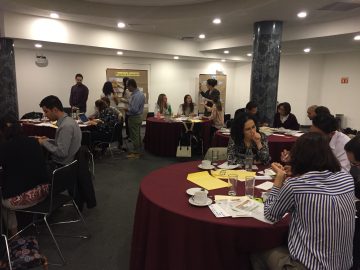
In this context, the discussion “The Insertion of the Emissions Trading System in Mexico’s research agenda” was held, bringing together representatives of Mexican universities to reflect on the opportunities it represents for the academic world in matters of regulation, implementation and analysis of results of the ETS Pilot Program. In addition, possible challenges were discussed, as well as solutions and possibilities for collaboration to avoid those challenges..
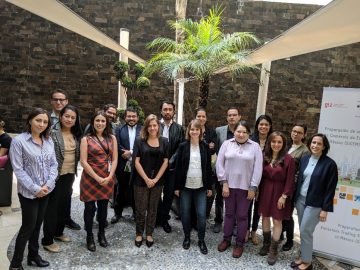
The breakfast took place on September 25th, 2019 at the Novit Hotel in Mexico City. The project “Preparation of an Emissions Trading System in Mexico (ETS)” implemented by GIZ on behalf of the German Federal Ministry for the Environment (BMU) organized the event, which was attended by distinguished universities such as the National Autonomous University of Mexico (UNAM), the Center for Economic Research and Teaching (CIDE), the Ibero-American University, the Anahuac University, the National Polytechnic Institute and the Mora Institute.
On September 26th, 2019, more than 100 representatives from academia, national and sub-national governments, associations and international cooperation organizations and private sector companies met to begin the work of the 5 priority areas to move towards a sector of efficient, resilient and low carbon buildings.
During the workshop of actors and the formation of working tables of the Global Alliance for Buildings and Construction Mexico (GABC_Mx), convened by the Alliance for Energy Efficiency (ALENER) supported by the International Energy Agency (IEA), the Programme for Energy Efficiency in Buildings (PEEB) of the GIZ and the World Resources Institute (WRI), the GABC_Mx Declaration was read out. It underlines that, although significant progress has been made in Mexico in terms of sustainable design of the urban environment and buildings, the country has the great challenge of working in a coordinated manner to achieve the established objectives of social development and fight against poverty, as well as those of sustainable development and climate change, which must be approached in an aligned manner.
The GABC_Mx is a space to facilitate the work in a coordinated way in the design and implementation of actions that consolidate a national agenda for sustainable, low carbon, safe and resilient building and construction, and that promotes the social and economic development of the population, considering the convergence and articulation of initiatives from different actors.
These works are aligned with the objectives of the Paris Agenda, with the implementation of the NDC of the construction and buildings sectors in Mexico, and promotes the GlobalABC Regional Roadmap Development for buildings and construction in Latin America, developed by the IEA and WRI.
ALENER and PEEB support the formation and monitoring of the working groups of the GABC_Mx to advance in the five priority areas: education and awareness, public policies, market transformation, financing and measurement and collection of data and information.
The PEEB is the first program that implements the GlobalABC roadmap for high-efficiency buildings internationally and is part of the International Climate Initiative (IKI) of the German Federal Ministry for the Environment, Nature Conservation and Nuclear Safety (BMU). PEEB is also implemented in Morocco, Tunisia, Senegal and Vietnam.
Mr. Arturo Echeverría and Mr. Carlos Carrazco Cota, focal points of the GABC_Mx, invited other actors who want to be part of the Alliance and contribute to any of the five working groups. For more information: acarrazco@ahorroenergia.org.mx
A cost-benefit analysis (CBA) is relevant in the prioritization and selection of climate change measures since it allows to calculate the economic viability and positive external aspects for effective implementation, facilitating the decision-making of one action against another. To include this analysis in the policy of the different levels of government, a series of workshops were developed in order to train public servants in the use of the CBA methodology.
A cost-benefit analysis (CBA) is relevant in the prioritization and selection of climate change measures since it allows to calculate the economic viability and positive external aspects for effective implementation, facilitating the decision-making of one action against another. To include this analysis in the policy of the different levels of government, a series of workshops were developed in order to train public servants in the use of the CBA methodology.
Under this context, within the framework of the “Vertically Integrated Climate Policies” Programs (VICLIM) and “Ecosystem-based adaptation to climate change in cooperation with the private sector in Mexico” (ADAPTUR) implemented by GIZ, three theoretical and practical workshops were held regarding this methodology. In the first part of the training, attendees learned the background of the CBA, as well as the basic concepts of social cost-benefit analysis and environmental economics to perform economic evaluations for environmental projects; specifically, those that contribute to sustainable development and low emissions.
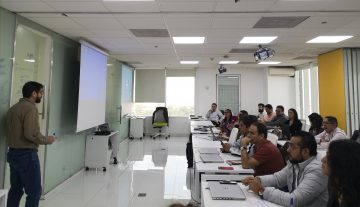
In a second practical part, the participants learned to use the CBA computer tool that was developed by GIZ, and can be consulted at www.acbgiz.org. It is designed to facilitate social cost-benefit analysis, without implying in-depth knowledge. Through this tool, attendees were able to model public investment projects and interpret the results of social profitability. This, together with the theoretical bases, will allow public servants to give recommendations on whether or not to carry out those projects and report on the costs and benefits that they imply for society.
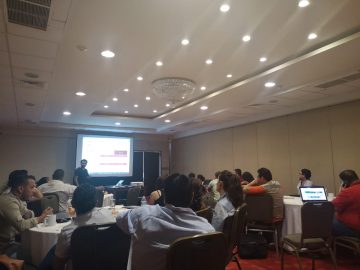
The workshops took place on August 30 in Guadalajara, on August 21 in Puerto Vallarta, and on September 26 and 27 in Mexico City. It was attended by municipal actors from the government of Puerto Vallarta and Costa Rica, as well as from intermunicipal boards and the Metropolitan Area Development Planning and Management Institute of Guadalajara . Likewise, public servants of the Ministry of Environment and Territorial Development of Jalisco (SEMADET), the Ministry of Environment and Natural Resources (SEMARNAT), Ministry of Tourism (SECTUR), National Commission of Natural Protected Areas (CONANP), National Institute of Ecology and Climate Change (INECC), and technical advisors of GIZ participated.
Para consultar:
Taller Adaptación al Cambio Climático – Análisis Costo Beneficio Social ppt.
Mexico has been facing enormous challenges due to climate change: from extreme weather events to severe droughts, in combination with a rapid urbanization process. The country´s ability to adapt is being tested and will require innovative strategies. Growing metropolitan areas across its territory are in dire need of new tools, such as urban labs, in order to learn how to face this unprecedented change.
In mid-June the “Morgenstadt: Global Smart Cities Initiative” was successfully launched in Mexico. The City Lab Saltillo, established in one of the oldest settlements of northern Mexico, had its official kick-off event with the active participation of multiple communities, such as academia, business, entrepreneurs, students, government and the German embassy. Saltillo´s Municipal Planning Institute is the anchoring institution partnering with Tecnológico de Monterrey, Mexico´s National Autonomous University (UNAM) and Saltillo Institute of Technology. The project is funded by the International Climate Initiative (IKI) of Germany´s Federal Ministry for the Environment, Nature Protection and Nuclear Safety, coordinated by the University of Stuttgart together with the Fraunhofer Institute. This proposal seeks to respond to global trends such as climate change and the great digital transformation, among others, which require local responses where cities play a crucial role.
The “Morgenstadt” methodology of the Fraunhofer Society integrates technological innovations, urban development and social and environmental premises to consolidate sustainable and inclusive cities. This global project integrates three cities around the world under the “City Labs” format. The participating cities are: in Asia, the city of Cochin in India, and in Latin America the city of Saltillo in Mexico, and the city of Piura in Peru. With a group of global experts, the sustainability profile of the participating cities will be analyzed to determine their priority areas, opportunities and critical areas that require innovative responses, where traditional urban development cycles are no longer adequate. The city is analyzed as a complex adaptive system where government, business, academia and citizens can co-design a route to a more sustainable future. Beginning in December 2018 and ending in November 2021, this project will strengthen local capacities for sustainability, through workshops and webinars with experts in the different areas covered, involving academic partners for the creation and management of the knowledge produced, with the objective of contributing to the formulation of intelligent national policies.
VICLIM’s contributions for the financing of climate actions at subnational level
Prepared by: Deutsche Gesellschaft für Internationale Zusammenarbeit (GIZ) GmbH
Vertically Integrated Climate Policies (VICLIM) The project is part of the International Climate Initiative (IKI) of the Federal Ministry for Environment, Nature Conservation, and Nuclear Safety (BMU).
For almost three years the VICLIM project promoted local climate policies and actions aligned with the national goals. Part of this work focused on capacity building and knowledge for accessing to local climate finance.
Background
Among the objectives of the Global Vertically Integrated Climate Policies Program (VICLIM) is the institutional strengthening and the development of instruments and mechanisms for vertical climate integration. The local implementation of climate policies necessarily entails the financing of new projects with a focus on climate change and, therefore, the access and management of additional resources. Within these objectives, VICLIM developed actions in the field of climate financing at the subnational level.
As antecedent, the results of the Report on the Regional Workshops with the States and their contribution to the 2017-2018 Nationally Determined Contribution (NDC) were taken as reference. It, highlights the broad interest of subnational levels on mechanisms, success cases, and capacity building around climate financing , due to the scarce public resources and the lack of technical personnel dedicated to the development of proposals and search for financing at the local level.
The main contributions of VICLIM to these demands are presented below, in order to generate useful information and strengthen governance and capacities regarding local climate financing.
Jalisco and its municipalities: Strengthening capacities to manage climate finance
One of the key partners in this topic was the state of Jalisco, through the Secretariat of Environment and Territorial Development (SEMADET). In August 2017, VICLIM supported a workshop on climate financing for the Inter-municipal Environment Boards (JIMA) of the state of Jalisco. This workshop presented the work done by GIZ in conjunction with the Jalisco SEMADET for the development of indicators that facilitate the process of prioritazing measures from its Regional Climate Action Programs (RCAPs) in the process of finding sources of climate financing. In addition, the common barriers and opportunities were presented among the JIMAs to access financing, among which the lack of technical capacities in project preparation, identification of funding sources, and financial instruments and mechanisms were highlighted.
Considering the results of the workshop, in 2019, VICLIM supported the development of a technical document to provide training to the JIMAs on how to prepare project proposals on climate change adaptation and mitigation measures. The document provides information on how to define adaptation or mitigation objectives and explain their co-benefits, activity development, , definition of different types of indicators and how to develop them for different projects, among others. These trainings will be given by late 2019 or early 2020, in collaboration with the GIZ program of the Mexican-German Climate Change Alliance.
VICLIM also supported the development of a general analysis of fiscal and market instruments for the state of Jalisco. The objective of this analysis was to identify areas of opportunity to capitalize the Jalisco State Environmental Protection Fund (FEPAJ), reduce greenhouse gas emissions (GHG) and increase its carbon sinkholes. The results of the project will be integrated into the internal planning of SEMADET.
Contact information: Arturo Javier Palero Castro, MSc, General Coordinator of Transversal Management to Address Climate Change, Ministry of Environment and Territorial Development (SEMADET). e-mail: arturo.palero@jalisco.gob.mx.
Integrating social and environmental benefits into decision making
Additionally, in collaboration with the “Ecosystem-Based Adaptation to Climate Change Program with the Private Sector” (ADAPTUR) of GIZ, three theoretical and practical workshops were held on a methodology for social cost-benefit analysis of climate change measures were carried out. These workshops covered the background of the CBA and modeling exercises of public investment environmental projects using the ACB computer tool. Together, this knowledge will allow public servants to give recommendations on the convenience of carrying out those projects and report on the costs and benefits they imply for society and the ecosystems. For more information about these workshops and the methodology click here.
Contact information: Ana Lorena Gudiño Valdez, ADAPTUR Advisor – Adaptation to Climate Change (EbA) with the Tourism Sector, GIZ. e-mail: lorena.gudino@giz.de
Identification of enabling conditions for local climate financing
In collaboration with the Secretariat of Environment and Natural Resources (SEMARNAT), success stories at the municipal level on climate finance were identified through desk research and interviews. This case series, details the projects, processes followed, type of financing obtained, enabling conditions, and success factors that made access to resources possible. With the purpose of allowing other municipalities to enable their local contexts and replicate success factors that allow them to increase their chances of accessing resources. The dimensions analyzed in each study were the following:
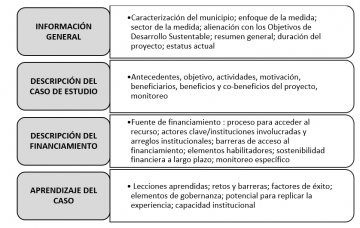
Till now nine case studies have been developed on a variety of topics such as alternative mobility, ecosystem-based adaptation (EbA) and waste.
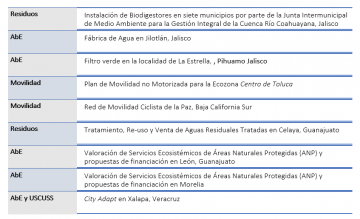
Although the number of cases is still small, as part of research learning, it is possible to identify some common elements among projects that have facilitated access to resources for climate action:
- Developing climate policies/sustainable development at the municipal level and linking them with the rest local policies allows labeling resources and gives municipalities an advantage to access international technical cooperation opportunities.
- Active participation of citizens at each stage of the projects. In some cases, the demands and pressures that citizens exerted on local governments prompted the search for solutions to access resources and implement projects.
- Evaluate financial flows to which the municipalities have access and identify the possibilities to increase collection.
- Concurrence of internal and external resources between institutions or between municipalities (regional actions).
- Leadership of local institutions/organizations and interest in the subject.
- Coordination with other actors/institutions and implementation of local governance models that allow an appropriation of projects by various actors.
Contact information: José Alfredo Vargas Gómez, Director of Regional Integration, Secretariat of Environment and Natural Resources, SEMARNAT. e-mail: jose.vargas[at]semarnat.gob.mx.
Exchange of experiences between GIZ projects in Latin America
VICLIM collaborated with the Working Group on Climate Financing for Public Sector Infrastructure of the Environmental Management and Rural Development Sector Network, Latin America and the Caribbean (GADeR-ALC), in a series of online weekly (webinars) that have aimed at publicizing the experiences, advances and tools developed by GIZ in the issue of climate finance in Latin America.
The first webinar was held on June 26 of this year, where VICLIM presented proposals for activities on the subject at the municipal level, including the results of a survey answered by 23 municipalities, mainly from Jalisco at the end of 2018. It highlighted the need for municipalities to understand mechanisms for access to climate finance sources, even for those with greater progress in this area.
The second Webinar took place on July 24 where VICLIM Mexico and Costa Rica presented case studies at the municipal and cantonal level and a study conducted in Costa Rica on the sources of climate finance available in that country. The last webinar was broadcast on September 25, in which VICLIM presented the results of climate finance research at the municipal level in Mexico, which was conducted through 9 case studies on various topics such as ecosystem-based adaptation, waste management and mobility.
Contact information: Itzel Alcérreca, Global Program Advisor “Financing Energy for Low-Carbon Investment – Cities Advisory Facility (FELICITY)”. Mail: itzel.alcerreca[at]giz.de.
In conclusion, it is reiterated that both the strengthening of capacities at the subnational level and the opening of channels and spaces to share experiences and knowledge, are a key part in supporting municipalities in the development and implementation of measures to combat climate change.
Mexico is a vast and one of the most biodiverse countries with a complex social structure, which is why the country recognizes the need to promote vertically and comprehensively work among the different levels of government. Therefore, it is necessary to analyze the municipal conditions in order to identify areas of opportunity for their contribution to the Nationally Determined Contribution (NDC).
Under the project VICLIM, an independent analysis on the conditions of the local governments of Mexico has been developed; a study that offers a view of the framework conditions of policy, governance and funding sources of the municipalities in terms of mitigation. In addition, the study allows to identify possible future collaboration opportunities betweenDeutsche Gesellschaft für Internationale Zusammenarbeit (GIZ) GmbH (German Cooperation for Sustainable Development) and the federal government of Mexico.
In the first chapter, the analysis contextualizes the international and national framework for the mitigation of pollutants and greenhouse gases (P&GHG) and addresses the role of municipal governments to contribute to Mexico’s NDC. Subsequently, in its second chapter, it details the public policy and governance structure regarding climate change in Mexico focusing on municipalities. In the third section, the analysis describes the climate policy at municipal level, which details climate change management, municipal climate action and energy management plans, as well as their challenges, and the creation of intermunicipalities as a way of local organization to deal with environmental problems. Finally, the fourth chapter delves into the issue of funding focused on mitigation actions at the local level , exposing the municipalities alternatives to access public financial resources, the obstacles they face and the areas of opportunity for these barriers.
Some of the areas of opportunity that the analysis identifies in climate policy at the municipal level are: lack of knowledge about climate change in municipalities; limited budget for the preparation of the Municipal Climate Action Programs (MCCP); lack of coordination by the federation for a general structuring of the MCCP, among others. In the case of financing, among the challenges mentioned in the analysis are the impossibility of applying the funds directly or the complex processes of calls.
Additionally, based on the study on the equivalence between NKI instruments and existing programs in Mexico, the analysis mentions the financing programs that the NKI had in 2017-2018 and compares them with the programs that the federal government of Mexico has. In this part, the program, modality, support characteristics, application processes, key actors and success stories are described.
In order for Mexico to fulfill its international commitments and manage to implement mitigation actions of P&GHG, Germany through the GIZ, has collaborated to strengthen and develop capacities. GIZ has also provided technical advice and promoted the implementation of climate protection policy. This analysis is part of the path to share knowledge and identify areas for improvement and future collaboration.
As the implementation of Ecosystem-based Adaptation (EbA) measures depends essentially on the alliance with local communities, the importance of building strong ties with individuals from the selected regions represents a key element that enriches not only the results of the project, but also the experience during its process.
Specifically speaking about the diagnostic experience of the project, during the consultation process carried out by Pronatura Mexico with the communities of the Valley of Mexico basin, it has been shown that the uniqueness of the work done by the people in the communities is directly related to their strong commitment to their values, people and nature. They have opened up to share their experiences with the lands they work and how climatic irregularities have been present in recent years, which is essential for the research phase of the project.
This has allowed the Pronatura Mexico team to immerse in the lives of these people and understand what they expect from the project, which facilitates an adequate response to their specific needs and a collaborative work process, not only in Mexico but in the four countries involved working simultaneously.
This is a project funded by the International Climate Initiative (IKI) on behalf of the German Federal Ministry for the Environment, Nature Conservation and Nuclear Safety (BMU). The project seeks to promote the implementation of Ecosystem-based Adaptation (EbA) measures in top priority basins of Mexico, Cuba, Guatemala, and the Dominican Republic, by strengthening local communities’ capacities, developing governance mechanisms, managing key actors to generate additional financing, creating awareness of water-dependent sectors and impacting on public policies.
Contacts in Mexico
Oswaldo Flores Armillas / Project Coordinator in Mexico
oswaldo.flores@pronatura.org.mx
Fernando Arzac / Regional Communication Coordinator
fernando.arzac@pronatura.org.mx
Vania Olmos Lau / Technical Liaison in Mexico
vania.olmos@pronatura.org.mx
Saúl Bustamante Hernández / Technical Liaison in Mexico
saul.bustamante@pronatura.org.mx
Specific financing for biodiversity is insufficient and not very diversified. It is essential to expand financing sources and increase the participation and investment of the private sector. To this end, the BIOFIN initiative, whose objective is to implement financing solutions for the conservation and sustainable use of biodiversity, has designed the Bio-economy strategy. This term encompasses those projects and processes that use the components of biodiversity as the main input, boosting economic activity, improving competitiveness and generating a positive impact on the accumulation of natural capital. At the end of July, BIOFIN convened more than 25 organizations, most of them from the civil society, that actively work with projects focused on conservation of nature in Mexico, at the Living Arts Center in Mexico City, with the objective of creating the Bio-economy Collective, in a participative manner.

BIOFIN’s bio-economy strategy is composed of three elements to be developed and implemented by BIOFIN with the support of the Collective as a transversal axis:
- Acceleration fund for productive projects with an impact on biodiversity
- Online bio-economy platform
- Strengthening of Wildlife Conservation Management Units (UMA)

This group will move from an individual vision to one of collective impact and common effort, with shared objectives that strengthen and replicate Bio-economy initiatives in Mexico as a tool to increase financing for the conservation and sustainable use of biodiversity. The session was facilitated by Cirklo, Innovation with purpose.

Some of the results of the session include the launch and socialization of the BIOFIN Mexico bio-economy strategy of and the creation of the Bio-economy Collective that will work in a coordinated manner to enhance the impact of their interventions, which will also avoid duplicating efforts, by increasing the amounts and sources of resources to boost sustainable businesses and investments with an impact on biodiversity.

With the intention of supporting the creation of the institutional conditions and the technical capacities that are necessary for the implementation of a Mexican Emissions Trading System (ETS), and in view of the next launch of the ETS Pilot Program in 2020, the project “Preparation of an Emissions Trading System in Mexico (ETS)” of the Deutsche Gesellschaft für Internationale Zusammenarbeit (GIZ) GmbH facilitates dialogue among actors of the public and private sector and civil society, so that they can identify, and subsequently perform, their responsibilities in the market.
In this context, the workshop “Emissions Trading System: Co-responsibility, Decarbonization and Climate Financing” was carried out to bring together members from different non-governmental organizations and civil society to reflect on the ETS, its role in the climate agenda and the needs for improvement regarding its effective implementation.
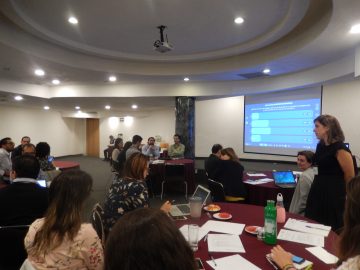
The workshop took place on September 9th, 2019 at the Diplomatic Hotel in Mexico City. It was convened by the Environmental Defense Fund (EDF) and Mexican Climate Initiative (ICM), with the support of the project “Preparation of an Emissions Trading System in Mexico (ETS)” implemented by GIZ on behalf of the German Federal Ministry for the Environment (BMU).
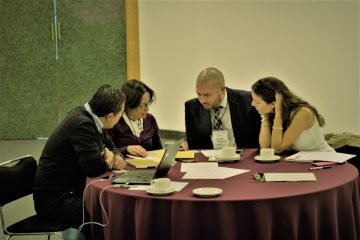
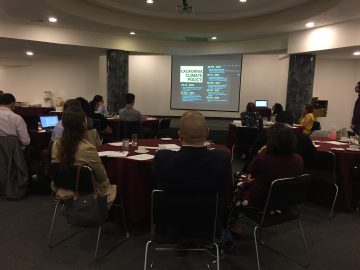
During the meeting a series of remarks and presentations occurred that encouraged reflection on the ETS. First, there was a presentation on why an ETS: cost-effectiveness in reducing emissions in regulated sectors (industry and energy) in support of meeting the climate goals, mitigation incentives in unregulated sectors, as well as co-benefits (health, green employment, etc.) and the generation and use of income to enhance these co-benefits. An interactive role-playing activity was also carried out (in which participants were invited to represent regulated facilities), to land the theory and understand the operation of the ETS in greater depth. In addition, there was an opportunity to hear from the experience of two California civil society organizations regarding their impact on the regulation and operation of the Cap and Trade system of this jurisdiction.
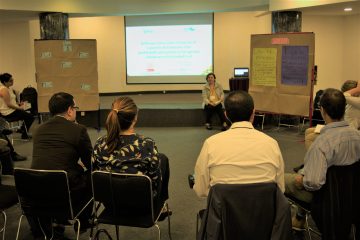
The reflection triggered by these activities revolved around both the regulation of the Pilot Program (whose process of public consultation has ended) and of what should be the next Operational Phase of the ETS. On one hand, a discussion was generated around the emission cap regarding its link to the country’s climate goals and its level of ambition. The importance of a compensation program in the rural sector, including forestry, cattle ranching and agriculture sector, as well as the transparency in the generation and use of income of an ETS was also commented.
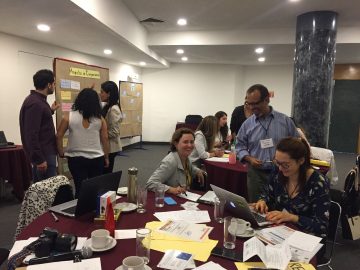
The lessons learned during the operation of the Pilot Program will be key to the implementation and design of the Operational Phase, and will have significant impacts on the efficiency of the System. Therefore, the relevance of transparency in indicators and results was discussed throughout the implementation of the pilot phase.
In the coming months, efforts to develop capacities, dialogue facilitation and additional technical studies to strengthen the design of the system, will continue to be presented on the “IKI-Alliance Mexico” blog. For more information on this topic, please contact us at: Comercio.Emisiones-MX[at]giz.de
Files for consultation:
The BioPaSOS project , implemented by the Tropical Agricultural Research and Higher Education Center (CATIE) together with the Inter-American Institute for Cooperation on Agriculture (IICA), with the support of the Ministry of Agriculture and Rural Development (SADER) and the National Commission for the Knowledge and Use of Biodiversity (CONABIO) and local partners in three territories of Mexico, builds different tools that contribute to the promotion of sustainable cattle raising, which are available for cattle ranchers, technicians, decision makers and the general public.


Among these tools, there is a virtual course entitled Agrosilvopastoral systems: a climate-smart alternative for cattle raising, which is supported by the Coursera platform.
Also, a series of virtual forums are available, addressing topics related to different themes and key dimensions of sustainable cattle production. In addition, there is a toolbox that provides elements to strengthen teaching. This toolbox is the result of participatory construction with producers and technicians from the three intervention territories of the BioPaSOS project and responds to the information needs expressed by local actors during the consultation processes. The virtual information repository is another tool that compiles important information on different studies, methodologies and advances in the implementation of sustainable cattle raising in Mexico and the region. This repository constitutes a solid basis for the implementation proposal carried out by BioPaSOS in the intervention territories.
Other tools, currently in development, include: the construction and design of scripts for the implementation of Field Schools (ECA), resulting from participatory diagnoses made in the territories; a serious technique that integrates documents such as tools, research advances, studies etc. that will be part of the information dossier generated by the project and available as a way of responding to the needs prioritization expressed by key actors in Jalisco, Campeche, and Chiapas.

Finally, the BioPaSOS project, in coordination with local partners in Jalisco, Campeche, and Chiapas, promotes and contributes to the construction of research agendas. These agendas will be a guiding tool for research priorities in the territories, based on information gaps that currently hinder the promotion of sustainable cattle raising.

More information:
Karla Salazar Leiva. Communicator. BioPaSOS project. CATIE
Juan Eduardo Betanzos. Jalisco Local Coordinator. BioPaSOS project. CATIE
Edwin Pérez Sánchez. Campeche Local Coordinator. BioPaSOS project. CATIE
Jose Antonio Jiménez-Trujillo. Chiapas Local Coordinator. BioPaSOS project. CATIE