The Inter-American Development Bank (IDB) and the Mexican Banking Association (ABM) have established a Climate Risk Capacity Building Program aimed at strengthening the institutional and operational capacity of Mexican banks to identify and manage climate, environmental and social risks. Within this program a new stage started with the objective to analyse the gaps in governance systems and in the management of climate, environmental and social risks in Mexican banks in relation to the TCFD recommendations.
The specific objectives of the project are to:
Provide knowledge about the main international trends and practical examples of banks that are aligning with these regulatory and/or voluntary trends.
Identify, through an international benchmarking exercise, best practices in governance within banks in Latin America and the Caribbean that are sustainable finance leaders in their context of operation and/or “early adopters” of the TCFD’s recommendations.
Develop a tool for the identification and analysis of EC&S governance structures and practices for the management of climate, environmental and social risks within banks in Mexico. The tool will allow the self-evaluation by banks of their performance regarding the implementation of TCFD’s recommendations for governance and climate risk management, as well as comparison with peers. Easy to use and accessible to all interested banks, the results of its application will allow the analysis of existing gaps, the identification of short and medium-term objectives and the visualisation of progress made in the implementation of TCFD’s recommendations.
Use the tool to evaluate the performance of a sample of 3-5 Mexican banks in terms of governance and practices for the management of climate, environmental and social risks.
Facilitate a training workshop with member banks of ABM and other interested banks where the tool and its possible applications will be presented, along with anonymous results of its application to those involved. A series of group exercises will be organised to analyse the main gaps and discuss possible barriers and enablers for climate risk management in Mexican banks. The workshop will also enable the elaboration of “road maps” for TCFD implementation through the identification of objectives, activities and timelines with respect to each criterion.
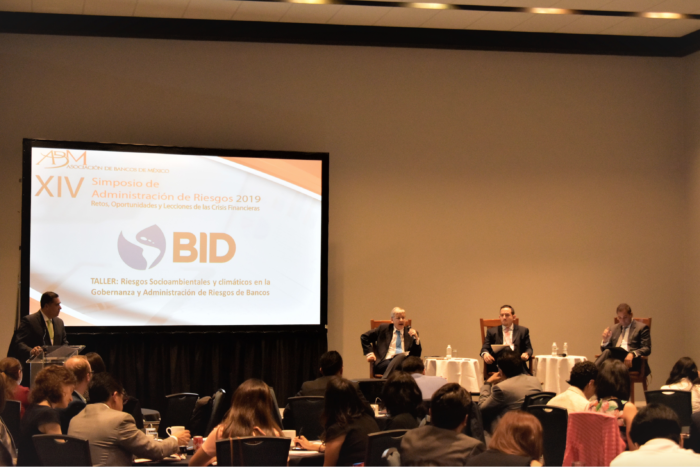
As part of this initiative, Acclimatise representative, Laura Canevari, was invited to present at a workshop organized during the XIV Symposium on Risk Management, held at the Hilton Reforma in Mexico City on the 29th of May. Here, she introduced the recent outputs from the UNEP-FI First pilot project with the banking sector on TCFD Implementation, and reflected on climate risks and opportunities best disclosure practices from around the world.
During the workshop, representatives from different financial institutions within the country engaged in dialogue to explore examples of governance and risk management systems for socio-environmental and climatic risks, and to learn about practical cases, tools and international reference frameworks that can help them pave the way to TCFD aligned disclosures.
Photo: Acclimatise News.
Opening remarks from Rafael del Villar Alrich, Governance advisor of the Bank of Mexico (one of 36 financial institutions in the Network for Greening the Financial System Initiative) were complemented by presentations from ABM, Banobras, Bancolombia Banamext as well as CEBDS Brasil and GIZ. As noted by Alan Gómez Hernández, Sustainability committee Coordinator from ABM, , climate change needs to be regarded as a fundamental issue impacting the private sector: A business topic with potentially significant positive and negative repercussions.
As noted by Virna Gutierrez (Banobras), these issues need to be recognised and tackled at high levels of governance within banks, with the support of risk management systems that can support the identification and evaluation of policies to mitigate potential risks and pursue potential opportunities. Steps are being taken to make this possible. In South America, for example, Bancolombia has recognised the role it has to play in financing the transition to a low carbon economy, with a well-established climate policy to inform their strategy. They are also active players in government conversations and have a very cohesive internal group within the bank that works to advance sustainability and climate risk management issues and engages directly with potential clients to foster the development of their green bonds and credit lines. These activities are all reported to the board of directors, which has established a target of US$10bn in climate investments by 2030.
The Mexican banks are also taking steps forward. Banamext SARAS (Sistema de Gestión de Riesgos Ambientales y Sociales) system, for example, establishes a comprehensive management framework that includes policies, procedures, tools and internal dissemination actions as well as training needs in order to identify, supervise and manage the exposure that the bank may have against potential environmental and social impacts within the credit allocation process. Similarly, they have also developed a self-assessment tool (MEDIRSE): A methodology to determine the impact of risks relating to social aspects of energy investments, in accordance with Bancomex’s due diligence process and SARAS system.
In addition, innovative collaborations are fostering the development of instruments that help Mexican banks better incorporate social, environmental and climate risks in their governance structures and that facilitate the alignment with the TCFD Recommendations. Such is the case of an initiative established by the Deutsche Gesellschaft für Internationale Zusammenarbeit’s (GIZ’s) Emerging Markets Dialogue on Finance (EMDF) Initiative (see also: Embedding environmental scenario analysis), with the support of the University of Cambridge Institute for Sustainability Leadership’s (CISL’s) Centre for Sustainable Finance, the Instituto Tecnológico Autónomo de México (ITAM) and Banco de México. The project aims to empower financial institutions across the banking, insurance and asset management sectors and to promote the integration of environmental scenario analysis into practice in financial decision making.
Whilst Mexican banks acknowledged the challenges of incorporating social, environmental and climate risks and opportunities within their governance and risk management systems, it remained clear that banks should embark on this process now (if they have not already). The process and outputs generated through the newly established Inter-American Development Bank project working with the Mexican Banking Association are designed to provide the required support.
This article belongs to Acclimatise. Its content is the sole responsibility of the autor.
El Banco Interamericano de Desarrollo (BID) y la Asociación de Bancos de México (ABM) han establecido un Programa de Desarrollo de Capacidades de Riesgo Climático destinado a fortalecer la capacidad institucional y operativa de los bancos mexicanos para identificar y gestionar los riesgos climáticos, ambientales y sociales. Dentro de este programa, se inició una nueva etapa con el objetivo de analizar las brechas en los sistemas de gobierno y en la gestión de riesgos climáticos, ambientales y sociales en los bancos mexicanos en relación con las recomendaciones de TCFD.
Los objetivos específicos del proyecto son:
Proporcionar conocimiento sobre las principales tendencias internacionales y ejemplos prácticos de bancos que se alinean con estas tendencias regulatorias y/o voluntarias.
Identificar, a través de un ejercicio de evaluación comparativa internacional, las mejores prácticas de gobernabilidad dentro de los bancos en América Latina y el Caribe que sean líderes de finanzas sustentables en su contexto de operación y/o “adoptadores tempranos” de las recomendaciones del TCFD.
Desarrollar una herramienta para la identificación y el análisis de las estructuras y prácticas de gobierno de EC&S para la gestión de riesgos climáticos, ambientales y sociales dentro de los bancos en México. La herramienta permitirá la autoevaluación por parte de los bancos de su desempeño con respecto a la implementación de las recomendaciones de TCFD para la gobernabilidad y la gestión del riesgo climático, así como la comparación con sus pares. Fácil de usar y accesible para todos los bancos interesados, los resultados de su aplicación permitirán el análisis de las brechas existentes, la identificación de objetivos a corto y mediano plazo y la visualización del progreso realizado en la implementación de las recomendaciones de TCFD.
Utilizar la herramienta para evaluar el desempeño de una muestra de 3-5 bancos mexicanos en términos de gobernanza y prácticas para la gestión de riesgos climáticos, ambientales y sociales.
Facilitar un taller de capacitación con los bancos miembros de la ABM y otros bancos interesados donde se presentará la herramienta y sus posibles aplicaciones, junto con resultados anónimos de su aplicación a los involucrados. Se organizará una serie de ejercicios grupales para analizar las principales brechas y discutir las posibles barreras y habilitadores para la gestión del riesgo climático en los bancos mexicanos. El taller también permitirá la elaboración de “mapas de ruta” para la implementación de TCFD mediante la identificación de objetivos, actividades y cronogramas con respecto a cada criterio.
Como parte de esta iniciativa, la representante de Acclimatise, Laura Canevari, fue invitada a participar en un taller organizado durante el XIV Simposio sobre Gestión de Riesgos, celebrado en el Hilton Reforma en la Ciudad de México el 29 de mayo. Aquí, presentó los resultados recientes del primer proyecto piloto del PNUMA-FI con el sector bancario sobre la implementación de TCFD y reflexionó sobre los riesgos climáticos y las mejores prácticas de divulgación de oportunidades de todo el mundo.
Durante el taller, representantes de diferentes instituciones financieras dentro del país participaron en un diálogo para explorar ejemplos de sistemas de gestión de riesgos y gobernanza para riesgos socioambientales y climáticos, y para conocer casos prácticos, herramientas y marcos de referencia internacionales que pueden ayudarlos a preparar el camino hacia divulgaciones alineadas al TCFD.
Foto: Noticias sobre Acclimatise.
Las palabras de apertura de Rafael del Villar Alrich, asesor de gobernanza del Banco de México (una de las 36 instituciones financieras en la Iniciativa de la Red para la Ecologización del Sistema Financiero) se complementaron con presentaciones de la ABM, Banobras, Bancolombia Banamext, así como de CEBDS Brasil y GIZ. Como señaló Alan Gómez Hernández, coordinador del Comité de Sostenibilidad de la ABM, el cambio climático debe considerarse como un problema fundamental que afecta al sector privado: Un tema de negocios con repercusiones positivas y negativas potencialmente significativas.
Como señaló Virna Gutiérrez (Banobras), se deben reconocer y abordar estos problemas en altos niveles de gobernanza dentro de los bancos, con el apoyo de sistemas de gestión de riesgos que puedan respaldar la identificación y evaluación de políticas para mitigar riesgos potenciales y buscar oportunidades potenciales. Se están tomando medidas para hacer esto posible. En América del Sur, por ejemplo, Bancolombia ha reconocido el papel que debe desempeñar en la financiación de la transición a una economía baja en carbono, con una política climática bien establecida para informar su estrategia. También son actores activos en las conversaciones gubernamentales y tienen un grupo interno muy cohesionado dentro del banco que trabaja para avanzar en temas de sostenibilidad y gestión del riesgo climático y se involucra directamente con clientes potenciales para fomentar el desarrollo de sus bonos verdes y líneas de crédito. Todas estas actividades se informan a la junta directiva, que estableció un objetivo de diez mil millones de dólares en inversiones climáticas para 2030.
Los bancos mexicanos también están dando pasos hacia adelante. El Sistema de Gestión de Riesgos Ambientales y Sociales (SARAS) de Banamext, por ejemplo, establece un marco de gestión integral que incluye políticas, procedimientos, herramientas y acciones de difusión interna, así como también necesidades de capacitación para identificar, supervisar y gestionar la exposición que el banco puede tener contra impactos ambientales y sociales potenciales dentro del proceso de asignación de crédito. Del mismo modo, también han desarrollado una herramienta de autoevaluación (MEDIRSE): Una metodología para determinar el impacto de los riesgos relacionados con los aspectos sociales de las inversiones en energía, de acuerdo con el proceso de diligencia debida de Bancomex y el sistema SARAS.
Además, las colaboraciones innovadoras están fomentando el desarrollo de instrumentos que ayudan a los bancos mexicanos a incorporar mejor los riesgos sociales, ambientales y climáticos en sus estructuras de gobierno y que facilitan la alineación con las recomendaciones de TCFD. Tal es el caso de una iniciativa establecida por la Iniciativa del Diálogo de Mercados Emergentes sobre Finanzas (EMDF) de la Deutsche Gesellschaft für Internationale Zusammenarbeit (GIZ) GmbH (Cooperación Alemana al Desarrollo Sustentable), (ver también: Análisis de la incorporación de escenarios ambientales), con el apoyo del Centro de Finanzas Sustentables del Instituto de Liderazgo para la Sostenibilidad (CISL) de la Universidad de Cambridge, el Instituto Tecnológico Autónomo de México (ITAM) y el Banco de México. El proyecto tiene como objetivo empoderar a las instituciones financieras en los sectores de banca, seguros y gestión de activos y promover la integración del análisis de escenarios ambientales en la práctica en la toma de decisiones financieras.
Si bien los bancos mexicanos reconocieron los desafíos de incorporar riesgos y oportunidades sociales, ambientales y climáticos dentro de sus sistemas de gobierno y gestión de riesgos, quedó claro que los bancos deberían embarcarse en este proceso ahora (si aún no lo han hecho). El proceso y los productos generados a través del proyecto recientemente establecido del Banco Interamericano de Desarrollo que trabaja con la Asociación Bancaria Mexicana están diseñados para brindar el apoyo necesario.
Este artículo pertenece a Acclimatise. Su contenido es de exclusiva responsabilidad del autor.
Mexico has committed to ambitious climate change mitigation goals, for which the contribution of the energy sector is essential.
This study presents the result of the evaluation of the convergence between Mexico’s climate change mitigation policies and energy policy at the national and subnational levels. The study, developed by the project “Enhancing the Coherence of Climate and Energy Policies in Mexico” (CONECC) of the Deutsche Gesellschaft für Internationale Zusammenarbeit (GIZ) GmbH (German Cooperation for Sustainable Development), analyzes whether climate change and sustainable energy policies considered in Mexico are aligned and enable the energy sector to reach its objectives in addition to fulfilling the climate goals that Mexico has assumed in its legislation and internationally.
The analysis considers the benefits which the convergence of policies (instruments, processes and governance structures) presents for the climate and energy sector, and identifies opportunities to move towards mainstreaming. The study also analyzes the public policies of both agendas, focusing on high energy consumption sectors: electricity, oil and gas, transportation, buildings, and industry.
The study results in more than forty recommendations that allow delineating action towards inter-institutional convergence. These include the need for strengthening institutional capacities, greater inter-institutional coordination based on instruments and processes, promotion of sub-national planning, attribution analysis, identification of mainstream responsibilities and dialogue between sector heads.
CONECC. Cover of the publication.
Before the climate challenge that cities around the world are facing, the goal of the Government of Mexico City (GCDMX) is the reduction of 22 percent of greenhouse gas emissions by 2030.
With the project of Sustainable Energy Transition in Public Buildings in Mexico City that participates in the FELICITY Global Program “Financing Low Carbon Infrastructure in Cities”, it seeks to promote the energy transition in public buildings of the GCDMX with efficient energy equipment and with sustainable energy management systems.
Photo: Time Out, Iván Macías. Mexico City, Mexico
FELICITY provides technical assistance to the Ministry of Environment (SEDEMA) in the process of gathering information to contribute to a replication of good practices in local, regional and global cooperation networks, in addition to providing external consultants to make a global assessment of buildings, and the project so that it is financially sustainable.
Within the framework of FELICITY technical assistance, SEDEMA convened an Integration Forum on June 20th, which aimed to promote the project with key stakeholders within the government, as well as the digital tools available to manage energy efficiency on each of the candidate buildings. The meeting was attended by 50 representatives from 9 departments of the GCDMX administration as well as 10 mayorships.
Photo: Frida Lira, FELICITY GIZ. Naschelli Ayala, Deputy Director of Climate Change, SEDEMA, welcoming the Forum Integration of Buildings to the Transition to Sustainable Public Buildings project in Mexico City
Among the main conclusions of the Forum are: the energy transition for different government agencies would help reduce millionaire expenses in electricity; supply of hot water for longer periods in the case of hospitals; obtaining sources of financing; as well as the selection criteria of buildings.
That is why the GCDMX, through SEDEMA, promotes the execution of urban infrastructure projects with low carbon emissions, in order to achieve a sustainability development within the city.
Photo: Frida Lira, FELICITY GIZ. Representatives of the dependencies and mayorships of the GCDMX
FELICITY is the initiative implemented by the Deutsche Gesellschaft für Internationale Zusammenarbeit (GIZ) GmbH (German Cooperation for Sustainable Development); with the support of the European Investment Bank (EIB) and the German Ministry for the Environment, Nature Conservation and Nuclear Safety (BMU) that provides technical assistance in the preparation of projects focused on low carbon infrastructure in cities.
The promotion of a global economy that takes into account natural environment preservation, biodiversity protection, sustainable management of resources and climate change mitigation and adaptation actions is one of the main challenges to be met in the future. This challenge requires the inclusion of all actors (public, private, corporate, individuals) and a series of policy instruments, which highlight the regulatory framework and the incentives to mobilize the necessary financial flows.
International agreements such as the Paris Agreement, the 2030 Agenda or the Sustainable Development Goals (SDGs) have highlighted the need to find ways to support, but also to finance long-term solutions to solve environmental challenges. Consequently, the exchange of information and experiences offers an opportunity to promote new instruments and innovative mechanisms for green financing through efforts aimed at producing changes in common financial practices.
In conceptual terms, there is a debate about how to define finance according to its applicability in the environmental sector. In this regard, the following definitions stand out:
Green Finance: According to information from the Deutsche Gesellschaft für Internationale Zusammenarbeit (GIZ) GmbH (German Cooperation for Sustainable Development), green finance is understood as the financing of investments that provide broad environmental benefits, such as reductions in greenhouse gas (GHG) emissions, reductions in water, air and land pollution, greater biodiversity or greater climate resilience. Green financing includes environmental financing, conservation financing for and climate financing.
Sustainable finance: The European Commission (EC) defines it as financing of investments that take into account environmental, social and governance considerations. It also includes a strong green financing component that aims to support economic growth while reducing pressures on the environment, reducing GHG emissions, combating pollution, promoting awareness and transparency about the risks they may have in the financial system.
There is a variety of concepts and approaches to assess “financing”, even among development banks, international cooperation agencies and governments. Based on the above, the definition provided is based on the methodology and mapping used for its implementation.
International Context
Since the signing of the Paris Agreement in 2015, the need to identify and channel resources with the aim of keeping the global average temperature rise below 2 degrees Celsius, and as close as possible to 1.5 °C, has increased. Regarding financing, article two of the Agreement indicates the need to make financial flows compatible in order to move towards a development that is resilient to climate and low in GHG emissions. Under the principle of common but differentiated responsibilities, the document recognizes the leadership role that developed nations should have regarding the transfer of financial resources to developing countries in order to help them achieve their mitigation and adaptation commitments. However, the ninth article invites all countries to develop the capacity to do so.
With regard to biodiversity, the main objectives of the Convention on Biological Diversity (CBD) are the conservation of biological diversity, the sustainable use of its components and the fair and equitable sharing of the benefits derived from the use of genetic resources. Regarding financing, a recognition of the value of biodiversity is essential and allows the mobilization of financing from multilateral, national and innovative sources. The Global Environment Facility (GEF) is one of the most important financial mechanisms at global level administered by the World Bank.
There have been several mechanisms to channel resources, including the Special Climate Change Fund (SCCF), the Adaptation Fund (AF) and the Least Developed Countries Fund (LDCF). At the end of 2011, the Green Climate Fund (GCF) was established, with the purpose of assisting the efforts of developing nations to respond to climate change. According to data from the GCF, as of January 2019, an equivalent of 10.3 billion dollars has been collected in commitments from 48 countries, regions and cities.
In addition to international funds, there is a Permanent Funding Committee, which is a specialized technical team that supports the UNFCCC in providing assistance to the Parties (understood as the State that has consented to be bound by the treaty’s guidelines) for a correct use of resources. Since its creation, it has focused on improving the coordination strategies of the different financing mechanisms available, with the purpose of rationalizing and mobilizing resources efficiently, as well as promoting the monitoring, reporting and verification of the support provided.
In this sense, since 2008, the German government has supported the implementation of projects for the fulfillment of the NDC and the National Strategy on Biodiversity of Mexico (ENBioMex) through the International Climate Initiative (IKI) of the Federal Ministry for the Environment, Nature Conservation, and Nuclear Safety (BMU) of Germany. Based on the foregoing, 18 bilateral projects have been implemented with an amount of 69.5 million euros; eight regional projects and 44 global projects.
According to the information of the Mexican Commission for the Knowledge and Use of Biodiversity (CONABIO), the mobilization of resources by the GEF to Mexico in the 2015-2018 period was for the amount of US $ 88.1 million. On the other hand, international resources for climate change in Mexico, during the 2014-2018 period, around $61,165,646,524 pesos were received from multilateral and bilateral public sources, which were distributed in 75 projects. There are also 12 other global projects in which Mexico participates together with several countries (such as Argentina, Brazil, Colombia, Honduras, Guatemala, Costa Rica, Peru, China, India, Indonesia, among others) and that amount to a total of $ 7,142,604 pesos. Likewise, 23 projects were identified whose implementation is expected to be carried out until the year 2021. Adding everything gives a projected amount of $ 32,935,768,463 pesos.
As shown in Figure 1, 53 % of financing in the 2014-2018 period comes mainly from the Inter-American Development Bank (IDB), followed by KfW as implementer (31%), AFD/KfW (7%) and the World Bank (5%).
As shown in Figure 2, the sectors that receive most support are energy (45%), housing, and environment sector. It is noticeable that the energy sector is the second most important emitter of greenhouse gases (GHG). However, it is important to continue encouraging the reduction of emissions in sectors such as transport and industry.
It is worth noticing that the main source of financing for climate change projects comes from the Multilateral Development Bank, which, although initially focused on offering technical and economic support at government level for issues of sustainable development and fight against poverty, now it has a greater role in providing financing to the private sector, as well as in leveraging resources from it.
According to the study “Diagnosis on multi-stakeholder coordination on Climate Finance“, Mexico is positioned as the second largest recipient of international resources for climate finance in Latin America, with a total of 686 million dollars approved between 2003 and 2017. This means that strengthening the capacity for management, allocation, use and transparency of resources obtained from international sources in Mexico would help to leverage greater resources from public and private sources to comply with their NDC.
National Context
In Mexico, the states have joined efforts in the development of a national policy on climate change and promotion of biodiversity, through the strengthening of their institutional capacities and the elaboration of a legal framework that allows the execution of public policies for the mitigation or adaptation. The General Law on Climate Change (LGCC), published in 2012, establishes a regulatory and national policy framework to address the causes and face the adverse effects of climate change, through the development and implementation of adaptation and mitigation measures and actions. The ENBioMex establishes the bases to promote, coordinate and harmonize government and society’s efforts for the conservation, sustainable use and fair sharing of the benefits derived from the use of the components of biological diversity and their integration in the sectoral priorities of the country.
The LGCC contains a variety of economic and financial mechanisms that stimulate the channeling of resources for the development of actions, projects and mitigation and adaptation programs in the public, social and private sectors. Funding in this area is mainly carried out in three ways: through the Climate Change Fund (CCF); through budget allocation reflected in Branch 16 of the Budget of Expenditures of the Federation (PEF) and the Transversal Annex 16.
Climate Change Fund (CCF)
The CCF aims to capture and channel national, international, public and private financial resources to finance actions against climate change. The Fund has as trustor the Ministry of Finance and Public Credit (SHCP), Nacional Financiera (NAFIN) as fiduciary and the Ministry of Environment and Natural Resources (SEMARNAT) as responsible and Technical Secretariat.
The Fund receives resources directly from the PEF and from other public funds, like contributions on payment of rights and uses according to the corresponding laws; donations from individuals or corporations; national or international, as well as contributions from governments of other countries and international organizations.
Branch 16 of the Budget of Expenditures of the Federation (PEF)
It is a legal and financial document that determines the expenditures made by the federal government from January 1 to December 31 of each year. Within the 16th Branch, for the year 2019, in terms of Environment and Natural Resources, resources are allocated to protect the flora and fauna, as well as the biological diversity of the country, also, various mechanisms of research, technological development and capacities to cope with climate change are considered.
Transversal Annex of Climate Change (AT16)
As part of the reforms for the restructuring and orientation of the budget, the PEF has integrated different cross-sectional budgets in order to identify and categorize the proportion of resources allocated to works, actions and services linked to a specific purpose; in this case, mitigation and adaptation to climate change. This is to expand or improve, in the short and medium term, public policies focused on guaranteeing the right to a healthy environment, as well as contributing to the monitoring and compliance with state, national and international commitments on climate change.
Resources are contemplated to: Secretariat of the Interior (SEGOB), Ministry of Agriculture and Rural Development (SADER), Ministry of Communications and Transportation (SCT), Ministry of Economy (SE), Ministry of Public Education (SEP), Ministry of Health (SSA), Ministry of the Navy (SEMAR), Ministry of Agrarian, Territorial and Urban Development (SEDATU), Ministry of Environment and Natural Resources (SEMARNAT), Ministry of Energy (SENER), Ministry of Tourism (SECTUR) and National Council on Science and Technology (CONACYT). It also considers state productive enterprises: Mexican Petroleum (PEMEX) and Federal Electricity Commission (CFE).
Financing in the area of Climate Change and Biodiversity in Mexico
According to the information presented during the dialogue “Perspectives on climate finance in Mexico 2018-2024“, since the CCF was created in Mexico, $ 183,012,375.32 pesos have been mobilized for 22 projects. The transversal informative Annex 16 of the PEF, in the last four years (2015-2018), has allocated $ 188 billion pesos. From green bonds, public entities have issued $ 3,714 million dollars; while the commercial bank 657 million dollars. Taking into account the tracking of the previous points, a mobilization of financing of $ 7,725 million dollars from 2014 to 2018 is estimated, which would represent approximately 6% of the goal of $ 126,000 million dollars that the implementation of Mexico’s NDCs would cost in terms of mitigation.
According to data obtained from BIOFIN, the estimation of the financial needs for biodiversity is around USD 461.9 million per year during the period 2017-2020, which represents a 46.7% increase in biodiversity spending, based on the exercise during 2015. The evaluation of financial needs includes: 1) Natural Protected Areas with an amount of 60 million per year estimated by the National Commission of Natural Protected Areas (CONANP); 2) Financing needs to cover the demand for Payments for Environmental Services (PES) estimated at USD 202.1 million by the National Forestry Commission (CONAFOR); 3) The financial needs of the ENBioMex and Plan of Action 2016-2030 are estimated at USD 191.4 million.
The Role of the Private Sector
There are several financing sources that come from public sources. However, they are not enough before scenarios of budget reduction at federal level or limitation of indebtedness with international organizations. Nevertheless, there are private sources that can help boost resources for leveraging projects and actions against climate change, and biodiversity promotion.
Governments must provide an environment of certainty and financial confidence to ensure that private actors see a potential market in climate change projects. The conditions at national, state and local level must generate the greatest possible certainty that investments in green projects will have a low risk and will be bankable, and it is important to clearly identify their environmental and economic benefits.
Private sources of financing include a wide range of local and international banks and financial institutions, commercial banks, private funds, pension funds and other sovereign funds, insurers, mortgage banks, and micro-financial institutions, among others. The opportunities have been given mainly in GHG mitigation projects, energy efficiency, renewable energy, waste management, green infrastructure and in the agricultural sector.
At the national level, the Green Finance Advisory Board (CCFV – made up of high-level representatives of the Mexican financial sector, such as: Pension funds, Insurers, Associations, Commercial Banking, Development and Multilateral Banking, Issuers, Investment Funds, etc.), has promoted the dialogue among different market players on how to encourage financing of green projects, influence market practices and mandates and/or investment regulations, in such a way that they contribute to the establishment of incentives to stimulate the development of the green finance market.
After recognizing the negative implications of climate risks on private investment, the private sector and financial organizations have implemented different initiatives to move from carbon intensive projects to sustainable projects and programs. As an example, we can mention the activities of the Banks of Mexico Association (ABM) and the Mexican Stock Exchange (BMV).
The ABM decided to demonstrate its leadership in improving the financial system in matters of sustainability and climate change, through the Sustainability Protocol of the Banks of Mexico. The document recommends a management framework and guidelines on sustainability for Mexican banks.
On the other hand, the BMV generated a sustainability index (CPI-Sustainable), to encourage Mexican emitters to implement sustainable policies and systems. In addition, BMV signed the Sustainable Stock Exchanges Initiative, to improve accountability and transparency, after which the Sustainability Guide for Emitters was launched to support companies in the implementation of sustainability strategies and disclosure of sustainability programs in the field.
Challenges in Financing Matters
One of the main obstacles in the matter consists of limited information on the existence of financial mechanisms and how their resources are applied to certain projects. A mapping of the different sources of financing available in the country for the public sector could be very useful in this regard. In addition, an information system on the projects implemented on climate change and biodiversity would help to coordinate the different existing sources to meet the goals set at the national level.
Likewise, a coordination mechanism with multi-sectoral and multi-level vision could allow the articulation of climate change actions in all sectors of the economy, including the public, private, financial, social and academic sectors. Another option would be to facilitate access to climate finance and training for small and medium enterprises.
There must be a strategy to encourage and guide the financial sector to develop actions on climate change and biodiversity and improve the knowledge of public and private financial institutions on the regulations and operation of the institutional framework of both areas. In addition to the above, the projects that can be bankable in the short, medium and long term should be identified.
Knowledge of the costs and risks associated with investments must be promoted, so that the financing is granted to projects with environmental and social benefits. Based on the above, a mapping of the existing financial mechanisms and their functioning should be carried out, so that biodiversity and climate change issues can be considered as important investment themes. Subsequently, indicators of the impact and results of the financed projects have to be created to know the effectiveness of the funds assigned to them.
Through a taxonomy on what climate or green financing means, channeling of resources to projects that have sustainable characteristics or benefit the environment could be facilitated. To do this, it will be vital to work within the framework of the Planning Law to integrate all the concepts that are key to identify such actions.
The IKI in Mexico in terms of financing
In order to support climate action and biodiversity protection, IKI projects in Mexico are working in the field of financing. So far, the IKI has encouraged cooperation with financial institutions to integrate environmental and social indicators in the decisions of loans and investments, development of financial products and risk management. In this sense, the IKI of the Federal Ministry for the Environment, Nature Conservation and Nuclear Safety (BMU) of Germany supports the implementation of the NDC and the ENBioMex in Mexico.
With the aim of exchanging experiences and sharing knowledge about energy efficiency and energy management systems learning networks (RdA), the National Commission for the Efficient Use of Energy (Conuee) and the Deutsche Gesellschaft für Internationale Zusammenarbeit (GIZ) GmbH (German Cooperation for Sustainable Development) presented the video Energy Efficiency and energy management systems Learning Networks.
The video introduces the concept of RdA, what are the implementation phases, what is its main objective and what actors are relevant for their development and implementation. Also, the video shares the experience of the pilot networks in municipalities of Aguascalientes, Coahuila and Morelos, and the benefits achieved through the implementation of this mechanism is mentioned. For example, in Coahuila, the implementation of the energy efficiency network in the pumping of drinking water, and the measures identified foresee an electric power saving that translates into the mitigation of almost 3,000 tons of CO2 eq and the saving of more than twelve million pesos.
In addition, success stories are presented in Germany with the implementation of learning networks supported by the National Climate Initiative (NKI) of the German government, where in some projects up to 15-20% reduction in energy expenditure has been obtained. The information, testimonies, and case studies presented in the video will help disseminate the learning networks mechanism at the municipal level in Mexico, and its potential to promote energy efficiency measures that translate into cost reduction, capacity building and, low carbon municipal management.
The following GIZ projects participated in the elaboration of the video: Vertically Integrated Climate Policies (VICLIM), Sustainable Energy Program (PES), and Energy Transition Preparation Program in Mexico (TrEM)
CiClim’s Newsletter
CiClim’s Newsletter is a communication mechanism that seeks to keep the interested public informed about the ongoing activities of the Climate Protection in the Mexican Urban Policy program.
You can see the different editions of the Newsletter below:
To learn more about the CiClim program, see the description here.
In light of the upcoming pilot phase of the Mexican ETS, which is set to begin in 2020, the GIZ project “Preparation of an Emissions Trading System in Mexico” (SiCEM) has been conducting a series of activities which include the development of technical studies to inform decision-making with regards to the use of Blockchain technology for an Emissions Trading Registry.
Following up on a previous study on the Potential of Blockchain Technology for Climate Policy, a more in-depth analysis was performed to evaluate the suitability of the technology for the Mexican ETS, generating specific recommendations for the Blockchain architecture and alternatives for developing the blockchain-based registry, including estimated development costs and timeframes.
In particular, the analysis identified that neither a centralized standard registry nor a decentralized blockchain-based registry was clearly superior in terms of its application to an ETS registry. Some of the crucial tasks performed in an ETS registry, such as emitting and allocating emission allowances, recognizing offset credits or opening and closing accounts, among others, are clearly the prerogative of the government and should be kept centralized. However, blockchain pre-defined smart contracts could improve the transparency of the cap-setting, allocation and offset-generating processes, as well as facilitate linking.
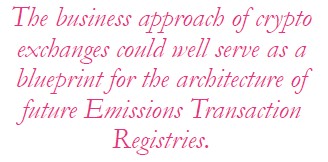
An interesting alternative is developing a hybrid architecture, using as blueprint that of crypto exchanges. In such exchanges, different layers could exist: a governing, centralized layer where the government could issue emission allowances and offset units; and a decentralized, permissioned blockchain layer where tokens corresponding to the number of units and allowances of the governing layer would be issued and distributed to different administrative wallets.
Such innovative approach to Emissions Trading would require both private and public sector involvement, as well as a clear regulatory framework such as that offered by Mexican Fintech Law. Further detail can be found in the publication.
The upcoming months previous to the pilot phase implementation provide with an opportunity to develop and test a hybrid centralized-blockchain approach to an emissions trading registry. Additional studies covering a variety of technical issues be published in the “IKI-Alliance Mexico” blog in the coming months.
Click on the image below to download the publication:
Puerto Vallarta continues to work for the development of its Municipal Climate Change Program (MCCP). The municipality conducted a workshop for the characterization and pre-prioritization of adaptation, mitigation and cross-cutting measures to climate change. The workshop was attended by different sectors to ensure the characterization of comprehensive measures.
With the Workshop for the characterization and Pre-prioritization of measures for the MCCP, Puerto Vallarta advances in the development of actions that will make up its Program and ensures that the latter is transversal and integrates all sectors. The workshop took place in Puerto Vallarta, Jalisco on May 20th and 21th, 2019.
Photo: GIZ Formation of the Working Group
This event was divided into two parts. The first consisted of the formation of a working group with representatives of five sectors: tourism, urban, fishing, agriculture and forestry. This is to ensure a transparent and participatory process in the definition of adaptation, mitigation and cross-cutting measures. Once the working group was formed, the previously developed measures were resumed, to complement them with the participation of the attendees. In addition, new issues of interest emerged, such as strengthening and promoting eco-tourism activities in the municipality, among others.
The second part consisted in the characterization and pre-prioritization of measures, where previously the prioritization methodology had been presented and the importance of considering measures that can be implemented in the long term was emphasized. Initially, the mitigation and adaptation measures identified in the previous workshop were presented and afterwards the cost estimation was carried out, as well as the estimation of the co-benefits considering the environmental, economic and social benefits. The last step was the estimation of the success factors taking into account the municipality’s capacities, compatibility with the regulatory framework and public policy, vision with the local actors and probability of success.
Photo: GIZ Dynamics for pre-prioritization of measures
The integrated results of all the sectors point out that in terms of adaptation measures it is important (in hierarchical order) to implement conservation and restoration actions in the basin, to separate the pluvial and domestic drainage, to establish a network of parks in the urban area, to protect the reefs, among others. In terms of mitigation, the results indicate with greater priority the installation of silvopastoral systems with a climate change perspective.
The elaboration of the MCCP of this municipality was supported by the Ministry of Environment and Territorial Development (SEMADET) of the State of Jalisco, as well as the Deutsche Gesellschaft für Internationale Zusammenarbeit (GIZ) GmbH, through the projects Vertically Integrated Climate Policies (VICLIM) and Ecosystem-based adaptation to climate change with the tourism sector (ADAPTUR).
Photo: GIZ Round Tables Discussion
Through the participation of different sectors, the integration of actors and experts visión is strengthened for the definition of adaptation and mitigation measures, as well as the transversality of these within a long-term vision to combat climate change .
For more information about the progress of Puerto Vallarta in the development of its MCCP, see the following links:
The policy of housing and urban development implemented in recent years has opted to promote mechanisms that foster more compact and dense city schemes, with a better location with respect to facilities and employment centers, as well as more sustainable housing with better quality of life for its inhabitants, and savings associated with their consumption in terms of electricity and water.
The Federal Mortgage Society (SHF) is the housing development bank of the Federal Government in Mexico. During the last years, it has promoted a series of initiatives with the purpose of guaranteeing better conditions both in homes and their environment.
Credit: Federal Mortgage Society (SHF). SHF logo.
SHF identified the difficulty of housing developers to carry out the urbanization tasks for housing, especially when seeking the integration of sustainability criteria in the developments. In this sense, it is necessary to establish that the provision of equipment and infrastructure corresponds to the municipalities, but given the financial conditions that most of them have, they end up being built by private agents who need to make additional capital efforts in order to ensure the minimum operating conditions for the projects, since in the market there is no financing product for urbanization. This situation has an impact on the final price of homes, and in some cases, generates pertinacious incentives, since the criteria under which such facilities and infrastructure are built are not the most appropriate.
Credit: LaPolítica. Urban Development.
Consequently, during 2017 the SHF designed a financing product for sustainable urbanization through the Housing Operation and Bank Financing Fund (FOVI), in order to ensure the provision of equipment and infrastructures “walls in” of the housing developments, as well as ensuring that the materials, construction systems, and technologies, would guarantee sustainability in terms of energy and water consumption use efficiency, as well as with respect to other socio-economic externalities associated with the inhabitants of the housing developments.
Aligned with this, SHF received support from the Inter-American Development Bank (IDB) with resources from the International Climate Initiative (IKI) of the Federal Ministry for the Environment, Nature Conservation and Nuclear Safety (BMU) of Germany to develop a methodology and impact assessment tool that helps mobilize financing in this type of development.
One of the great challenges of this project is to create awareness of sustainability in the developers; and to quantify the mitigation of Greenhouse Gases (GHG), in order to develop the ability to participate in a carbon market that economically encourages this sector.
In light of the upcoming pilot phase of the Mexican ETS, which is set to begin in 2020, the GIZ project “Preparation of an Emissions Trading System in Mexico” (SiCEM) has been conducting a series of activities which include the development and dissemination of information to support a better understanding of the ETS and its interaction with other policy instruments.
Mexico is committed in the fight against Climate change. Such commitment is reflected in the Climate mitigation targets set both in its Nationally Determined Contributions (NDCs) and its reform to the General Climate Change Law in 2018. To address its commitments, the Mexican government has established a variety of measures: among them, the ETS emerges as a key instrument in the promotion of a low-carbon development and the achievement of its sectoral climate targets.
An ETS is a market-based instrument to reduce Greenhouse Gas emissions. It operates under the principle of ‘Cap and Trade’ (see factsheets), creating a market for emission permits and incentivizing regulated entities to comply in the most cost-efficient way. In parallel, other economic instruments have been implemented in Mexico, creating additional incentives to encourage the transition to a low carbon economy: the carbon tax, and the clean energy certificates (CEL, for its acronym in Spanish).
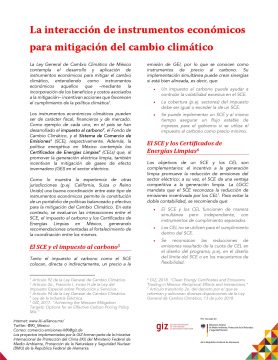
Experience from other jurisdictions (e.g. California, Switzerland or UK) shows that an appropriate coordination between these different instruments allows for the conformation of a well-balanced and effective Climate change mitigation policy portfolio. Two analyses performed for the Mexican context (Interaction between ETS and CEL, and Options for an Effective Carbon Policy Mix) culminated in a series of recommendations for the simultaneous operation of the ETS, carbon tax and CEL, creating synergies and harnessing the individual potential of each policy instrument to potentialize climate mitigation efforts. The key recommendations have been included in the following document (in Spanish):
Photo: GIZ SiCEM. Interaction between economic instruments for the reduction of Greenhouse Gases
The upcoming pilot phase provides with an opportunity to test the interaction between the Mexican ETS and other policy instruments. Additional studies covering a variety of technical issues be published in the “IKI-Alliance Mexico” blog in the coming months. For more information, please contact us at: Comercio.Emisiones-MX[AT]giz.de
In the framework of the project Integration of Biodiversity in Mexican Agriculture (IKI IBA), on June 3rd, a local subsidy project was formalized with Farmers in Sustainable Axes AC (ASEAC), an organization formed by small corn producers of temporary project of the municipality of Apaseo el Grande, Guanajuato, with the objective of contributing to integrate biodiversity into agriculture, improve the quality of life of farmers, support food security, mitigate and adapt to climate change.
Photo: IKI IBA project. Creole corn produced with sustainable techniques in Guanajuato
The project seeks to consolidate the productive model of sustainable corn that has been promoted by this group of producers in the eastern region of the State of Guanajuato, Mexico, for more than 10 years. This model, implemented with the support and help of Dr. Alfonso Aguirre of the National Institute for Forestry, Agriculture and Livestock Research (INIFAP) Experimental Campus Celaya, uses five main areas: conservation tillage, soil nutrition, ecological pest management, selection of seeds and adequate storage of the selected seeds, which is of great relevance for being native maize. Prior to this change in the production model, farmers harvested around 300 to 500 kilograms of corn per hectare. Today they produce between 4 and 5 tons of corn per hectare without the use of agrochemicals.
Photo: IKI IBA project. Signing of the agreement with Guanajuato producers
Currently, these farmers recognize and disseminate the importance of sustainable soil management practices that respect biodiversity, and maintain healthy ecosystems in their environment for the success of their crops. With these productive models adapted to the local context, made by the local farmers themselves who directly receive the benefits, and which are sustainable with the planet, they contribute to food security, conservation and sustainable use of biodiversity as a new model to face climate change.
Photo: IKI IBA project. Group of producers with GIZ Mexico staff
The local subsidy project formalizes the collaboration of ASEAC with the Deutsche Gesellschaft für Internationale Zusammenarbeit (GIZ) GmbH and forms part of the International Climate Initiative (IKI) of the Federal Ministry for the Environment, Nature Conservation and Nuclear Safety (BMU) of Germany.
Photo: IKI IBA project. Cornfield producers in Guanajuato