
The Taxonomy is a frame of reference (with criteria and indicators) that enables the classification, organization, and evaluation of various sub-branches and economic activities according to their contribution to the country’s climate change and/or sustainability objectives – in other words, classification of what is green and what is not. The Reporting Framework is the mechanism that accompanies the taxonomy to include the elements of sustainability in the operation of a bank and, with it, monitor investment flows and report results.

The Mexican-German Climate Change Alliance of the Deutsche Gesellschaft für Internationale Zusammenarbeit (GIZ) GmbH, and the Mexican Banking Association (ABM) have promoted the development of a methodology for the taxonomy of green finance and a reporting framework for Mexican banks through the project “Design and Management of a Reporting Framework for Green Financing in Commercial Banks in Mexico“.

The beginning of the project consisted of a revision of existing experiences: on the one hand, international ones, to understand the best practices; and on the other hand, national ones, to assimilate local needs and capacities. By referring to the main international initiatives, such as the taxonomies of China, the European Union, and the Climate Bonds Initiative, we also sought to understand their methodologies to harmonize the development of this project, to be part of a system of world taxonomies that can provide the investor with certainty.

 

Credits: Shutterstock. For the development of a Mexican banking taxonomy, it is necessary to consider national and international experiences.


International Initiatives

China 

In 2012, China pioneered the development of a green financial system by standardizing a series of policies, institutional arrangements, and regulations to direct private funds towards the green industry. The country’s regulators designed two taxonomies: credits (2013) and green bonds (2015). Both taxonomies are mandatory, have the objective of building a comprehensive green financial system, and direct the allocation of resources mainly to projects that reduce emissions, prevent pollution, and save energy.

European Union

In 2018, after the publication of the European Union Action Plan on Sustainable Finance, the technical report of the Taxonomy of Sustainable Finance was prepared, published in March 2020.

It consists of a methodological framework that can provide Technical Evaluation Criteria that define the level of environmental sustainability of economic sectors and activities. These criteria were developed for more than 70 activities contributing to the fulfillment of objectives of mitigation and adaptation to climate change. The European Union has six environmental objectives that must be met and the projects that are financed –to obtain the “green” label– must try not to do “significant damage” to any of them during their life cycle.

This taxonomy was designed to be used both by the European Union member states and by financial market participants that offer products labeled as “sustainable financing or investments” since it is useful for various financial instruments. Due to its complexity, scope, legitimacy before financial regulators, transparency, and alignment with science, it is considered the world benchmark.

Climate Bonds Initiative (CBI)

Its taxonomy is intended to guide issuers and investors of green and climate bonds; developed in 2013, and regularly updated based on science, the emergence of new technologies and CBI standards. It is a benchmark for governments and regulators interested in ensuring the green integrity of new financial products.


Mexican Experiences

The Mexican financial system does not yet have a green financing taxonomy; however, there are several initiatives for a green finance development framework that position the country at the Latin American forefront in this area.


  • Banking Sustainability Protocol (2016). Promoted by the ABM to participate in the transition of the Mexican economy towards a competitive economy with low carbon emissions. It currently has 26 adherent institutions.
  • Green Finance Advisory Council (2016). Forum for exchanging experiences and generating proposals for the financial system to advance the green finance agenda.
  • First proposal for a climate finance reporting framework for commercial banks (Internal ABM-GIZ project, 2017). Seminal project of the current one with a framework for measurement, reporting and verification of climatic financial flows in commercial banking.
  • Methodology for evaluating the impact of Adaptation and Mitigation of Climate Change (SHCP-SEMARNAT, 2019). It aims to guide the analysis of public financing, integrating criteria, definitions, and indicators to link and identify the contribution of the Federal Government to the fulfillment of the Mexican commitments and objectives in the area of ​​climate change.
  • FIRA Methodology for the First Green Bond in Agriculture (2019). Methodology to certify the first Mexican green bond in agriculture and identify green investments that facilitate the transformation of the production of certain open field crops towards one under the protected agriculture system.
  • Financing and certification of environmental infrastructure through the North American Development Bank (NADB). More than 250 certified and financed environmental infrastructure projects in the US-Mexico border region.


Best Banking Practices

Additionally, five commercial banks with operations in Mexico –representing 69% of total bank assets– have been pinpointed for their sustainability strategy; four of them contemplate a green financing goal along with its identification methodology. Sectors of interest: clean energy, energy efficiency, green buildings, clean or sustainable transport, and clean technology.


Conclusions

The review of the context for the development of green finance, as well as the best national and international practices in its reporting, have allowed us to understand that a Mexican taxonomic system requires three elements:


  1. Harmonization with best international practices: certainty for investors in search of opportunities in green assets must be supported by the comparability of taxonomic systems. They do not need to be the same, but they do need to be harmonized with comparable methodologies.
  2. Engagement in the reality of the Mexican economy and ecosystems, as well as the specific capacities of financial institutions. By adapting to different realities, taxonomies may have a different focus and development, while maintaining their comparability. For this, transparency in the process of generating the Technical Evaluation Criteria is essential.
  3. Framing the green finance taxonomic system within existing initiatives. This system must take advantage of initiatives that have credibility, legitimacy, and dynamism. Don’t create parallel structures that are inefficient and unnecessary. This point refers not only to financial markets but to the economy as a whole.
 

In a context of wide national and international recognition regarding the risks that climate change presents to the financial sector, key academic actors have joined the international cooperation efforts to develop a roadmap that will guide regulators and other financial entities in carrying out an analysis of environmental scenarios that is consistent with the national context.

In 2018, the World Economic Forum named extreme weather events, natural disasters, and failures to mitigate and adapt to climate change among the top five global risks in terms of probability and impact. Thus, in the last five years, important steps have been taken at the G-20 level to ensure that the financial system considers environmental risks and, consequently, that capital is appropriately allocated to support sustainable economic development.

In Mexico, the average annual cost of natural disasters has increased considerably. In this context, it is imperative that Mexican financial institutions and regulatory authorities take into account the material sources of environmental risks.

To facilitate such a process in Mexico, the Emerging Markets Dialogue on Finance (EMDF) of the Deutsche Gesellschaft für Internationale Zusammenarbeit (GIZ) GmbH, and the Center for Sustainable Finance at Cambridge University’s Cambridge Institute for Sustainability Leadership (CISL) joined forces with the Autonomous Technological Institute of Mexico (ITAM) and Bank of Mexico (Banxico) in a project to promote the publication of a report on the integration of the analysis of environmental scenarios in financial decision-making in October 2018. This project took place in parallel with one carried out in South Africa, in cooperation with the South African Treasury Department. The project results include two roadmaps, tailored for regulators and financial institutions in South Africa and Mexico, on how to develop analyses of environmental scenarios that are relevant in their national contexts.

Finally, with the support of the Mexican-German Climate Change Alliance and Bank of Mexico, the Spanish version of the report “Embedding Environmental Scenario Analysis into Routine Financial Decision-Making in Mexico” is available in Mexico.

By 2030, there will be an increase in both the population and tourists in San Miguel de Allende (Guanajuato), which is why it is estimated that the costs of water provision will increase by at least 25% compared to today.

However, the question is, will there be enough drinking water to meet basic needs? According to Conagua studies, the aquifers that provide water to this world heritage city are already overexploited. Shortly, climate change scenarios estimate a decrease in rainfall throughout most of the year, which could affect the replenishment of the aquifer by up to 14%.

This indicates that, in a trend scenario, a Zero Day will arrive, as was the case in Cape Town (South Africa). At that point, the replenishment of the aquifer will be less than what is being extracted, and there will not be enough water for the population, meaning extreme actions would have to be taken.


To avoid this, the municipal government of San Miguel de Allende launched the Climate Change Assistance Program last month, starting in the communal lands of Doña Juana and San Agustín González. They have been the first to initiate the restoration of forests and soils in 83 semi-desert hectares, through the reforestation of 19,000 native plants and the construction of hand-made dams using stones and meshes.

Likewise, the rightsholders of the communal lands owners of El Salitre and Los Torres have begun preparations for the rehabilitation of soils on 550 hectares of land, as part of the Payment for Environmental Services agreement signed between the municipal government, the beneficiary communal lands, and the National Forestry Commission (Conafor).

These ecosystem-based adaptation measures aim to reduce the risk of water scarcity and soil erosion in the municipality and, in the short term, create temporary jobs for the people of San Miguel, in the face of the crisis caused by COVID-19.

The program is led by the municipal government of San Miguel de Allende with financing and cooperation from various actors, including a developer in the real estate-tourism sector, representatives of the communal lands of San Agustín González, Doña Juana, Los Torres, and El Salitre, Conafor, and technical advice from the Deutsche Gesellschaft für Internationale Zusammenarbeit (GIZ) GmbH, as well as from civil society organizations Salvemos al río Laja, GAIA, Guanajuato Conservation Corps and Vía Orgánica.

More than half of the world’s population lives in cities, and this number is set to increase to more than two thirds by 2030. Cities are responsible for approximately 70% of greenhouse gas (GHG) emissions.

Climate change requires the implementation of actions on a local level since global agreements are not enough in this fight. Thus, mainstreaming climate change and urban planning will promote a transition to neutral cities adapted to climate impacts, as well as contributing to compliance with the Paris Agreement and the 2030 Agenda.

For these reasons, the Ministry of Environment and Natural Resources (SEMARNAT), the Mexican Association of Municipal Planning Institutes (AMIMP), with the support of the Deutsche Gesellschaft für Internationale Zusammenarbeit (GIZ) GmbH through the Mexican-German Climate Change Alliance project, launched an online survey from April 20 to May 29, 2020.


Credits: GIZ. Presentation of results of the survey “Climate Change and its Impacts on Municipal Planning”


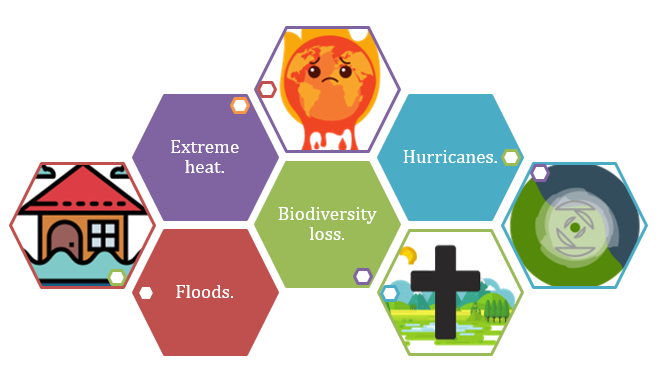
The results of the survey “Climate Change and its Impacts on Municipal Planning” were presented on June 8, 2020. The survey collected information from 35 Municipal Planning Institutes (IMPLANES) located in different parts of the country, thus realizing a complete view of the entire territory. The main climate risks detected in the areas of incidence are:


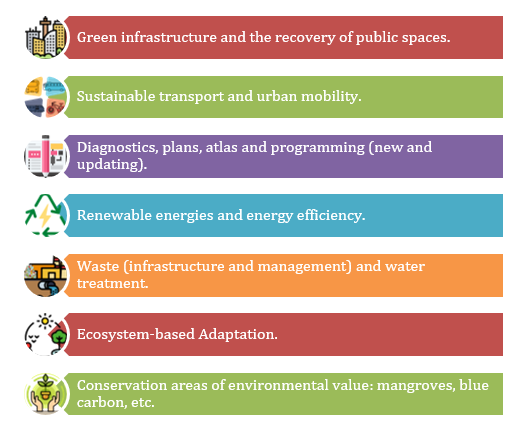
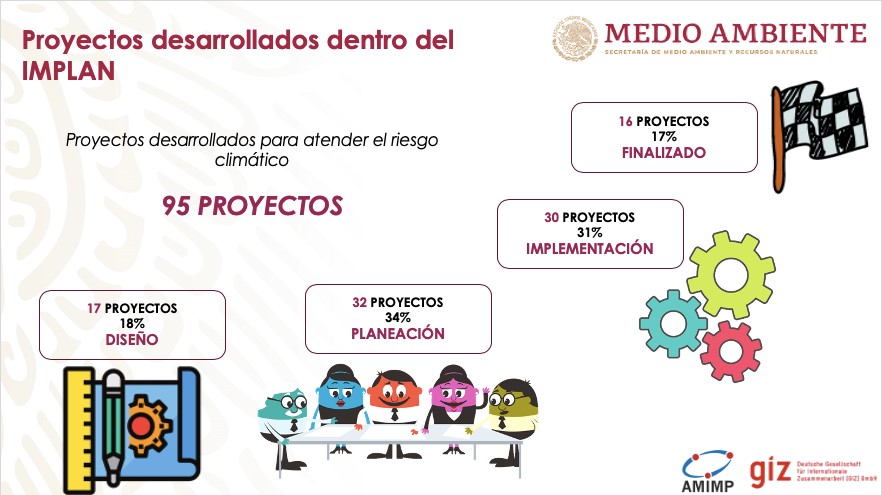
Furthermore, it was possible to identify 95 projects that are in different stages of implementation in the urban-rural sector, the main themes being:


It is important to note that despite the barriers faced by IMPLANES (for example, a lack of budget and the change of priorities in the administration), they have managed to make gradual progress in the implementation of their projects, with positive impacts in environmental, economic, and social aspects.


Credits: GIZ. Projects developed by IMPLANES and their stages.


Finally, they have detected their initiatives’ contributions to the fulfillment of the Sustainable Development Goals, especially SDG 11. Sustainable Cities and Communities, 13. Climate Action and 3. Well-being and Health.

The next step is mapping and working with different actors to allow for articulation between sub-national governments through the exchange of experiences. To facilitate this, monthly webinars and Digital Support Groups for Climate Action (GAAD) are being held bi-monthly from June to February 2021.

You can download the presentation and the webinar review to see the results in detail (in Spanish)!

The crisis resulting from the spread of COVID-19 implies a challenge on a global scale. Economic projections already indicate a decline in different regions around the world, with particular vulnerability for Latin America.

In this adverse context, different spaces are being opened for dialog and debate, to generate agreements that can guide the economic and social recovery along a sustainable path.

In order to foster these spaces for exchange, the Deutsche Gesellschaft für Internationale Zusammenarbeit (GIZ) GmbH accompanied WRI Mexico in the initiative “Sustainable Revolution: Dialogues for Recovery, Resilience, and Equity”. Other accompanying allies include the World Wildlife Fund (WWF), the Inter-American Development Bank (IDB), the Climate Initiative of Mexico (ICM), and the Economic Commission for Latin America and the Caribbean (ECLAC). Every week between June 9 and July 15, the initiative has a different thematic focus (such as cities, mobility, forests, energy, and green financing), offering a space for an exchange through high-level panels, multi-stakeholder tables, and webinars.


Credits: WRI Mexico. Schedule of sessions of the initiative “Sustainable Revolution: Dialogues for Recovery, Resilience, and Equity”.


At the opening event on June 9, the WRI executive director, Adriana Lobo, announced that a roadmap will be published at the end of the work sessions, with inclusive solutions for all sectors of society.

‘The objective of this initiative is to activate multisectoral dialog to identify priority issues and possible agreed lines of a solution, through a digital offering of top-level panels, talks, and sector tables, which allow us to position and promote processes to transit to environmentally friendly, resilient, and equitable economies.’ – Adriana Lobo, Executive Director of WWF.

From GIZ Mexico, the importance of the climate crisis and the need to join efforts to reconcile the economic with the environmental agenda was emphasized. Also, the following areas of collaboration were anticipated: resilient cities, mobility, energy, biodiversity, green financing, and collaboration with sub-national governments.

‘At GIZ, we want to contribute to these issues, and we are also very willing to listen and learn from our partners, as well as participants. It is important to come up with an overview that can guide Mexico’s green recovery’ – Dennis Quennet, director of GIZ’s Cities, Transport and Industry programs.

In the first prestigious panel, which took place following the inauguration, reflections were shared on the global challenge implied by the current economic, social, and environmental crisis. From the Mexican Ministry of Foreign Affairs, Martha Delgado Peralta, Under-Secretary for Multilateral Affairs and Human Rights, stressed the importance of linking gender issues to environmental issues and focusing on the well-being of communities in the recovery from the crisis.

Then ECLAC’s executive secretary, Alicia Bárcena, highlighted how the crisis caused by COVID-19 has revealed a series of structural problems in the current economic model in Latin America today. She stated: ‘We must prioritize sectors with great impetus for sustainability: clean energy, development of the links between water/soil / biodiversity, digital connectivity and electric public transport, health and mobility infrastructure, and the care economy’


Credits: WRI México / CEPAL. Structural problems in Latin America.


The second high-level panel of the conference focused on the specific challenges faced by Latin America in this context. Within this framework, Iván González Márquez, from the Mexican Ministry of Environment and Natural Resources (SEMARNAT), stressed the need to tackle the climate crisis with concrete measures. He explained that a holistic transition model is being proposed by the dependency, involving not only the government but also sectors of civil society. It includes seven environmental transitions: forest, agroecological and fishing, water, energy, biocultural, urban-industrial, educational and citizen-based, and environmental justice and governance.

At the end of each panel, there was an opening for questions from the public, with citizen participation encouraged. To review the agenda for the coming weeks, you can consult the official website of WRI Mexico. The next online event will take place on June 15 within the framework of Cities Week, with the theme: “Urban Inequality and Air Quality during the Pandemic: Emerging Social and Economic Challenges.”

In the current health crisis we are experiencing, the environmental issue has become important and deserves to be placed at the center of the public health discussion. In fact, various Natural Science research institutes have pointed out that this crisis had its origin in the interruption of the delicate environmental balance. Factors such as habitat destruction, capture, trafficking and consumption of wildlife have represented favorable conditions for the SAR-CoV-2 virus to become contagious to humans. This is why today, more than ever, the protection of natural resources and the environment is crucial.

For this reason, it is important to ask ourselves: What will happen after the pandemic? What will be our role in this return to a “new normal”? What are our alternatives? How can we identify these measures or solutions? Which actors should be added? Which communication strategies should be promoted at a territorial level?

We must acknowledge that the main cause of the spread of this disease is the poor relationship that humans have established with the environment. Therefore, we have to generate a new, more harmonious relationship between society and nature. This is the only way to avoid similar situations: not only those associated with health problems, such as the emergence of new epidemics and their escalation towards pandemics, but other phenomena that have been documented with scientific evidence, such as the loss of biodiversity, climate change, water loss, and the reduction of plant cover and soil erosion, could lead us to critical situations for humanity.


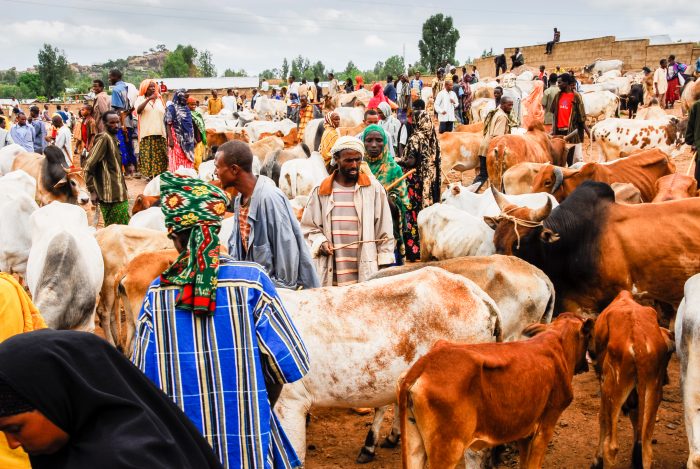
Credits: Shutterstock. The increase in domesticated animals for human consumption has a large impact on ecosystems.


One of the most relevant causes is the change in land use, explained by the increase in extractive and productive activities, deforestation, and the expansion of urban areas. Another relevant factor is the increase in the proportion of domesticated fauna (for example, cattle, pigs, and poultry) in recent centuries as food for human consumption, alongside a detriment in the proportion of wild fauna. Consequently, this combination of elements has expanded the universe of pathogens associated with domesticated fauna, specifically viruses, bacteria, fungi, parasites, prions or misfolded proteins. These pathogens play a role, and ecosystems, both terrestrial and marine, depend on their activity. For example, plants and animals release residues into the soil (carbon, nitrogen and sulfate, among others) that, when degraded, are used by bacteria as food. Thus, it is important that anthropogenic activities – and the different sectors involved in the environment – become aware of this and act responsibly, maintaining the natural balance.

For these reasons, the Nationally Determined Contributions (NDC) presented in 2015 by the Government of Mexico, and now in 2020, subjected to a review and update process, should identify concrete actions, opportunities, and needs, taking into account the value of natural resources, ecosystems, and their services to human and planetary health that provide the means for their implementation at different scales in the country.

Throughout 2019, areas for improvement were identified in the socio-economic evaluation of Comprehensive Urban Solid Waste Management (MSW) projects, in particular the methodologies carried out by the Center for Studies for the Preparation and Socioeconomic Evaluation of Projects (CEPEP) and the Financing Energy for Low-Carbon Investment – Cities Advisory Facility (FELICITY) of the Deutsche Gesell­schaft für Internationale Zusammenarbeit  (GIZ) GmbH, with the support from the PIAPPEM consultancy. These methodologies will help the municipalities in decision-making for the implementation of projects.


Credits: Felicity. Own. Event Banner


In November, CEPEP and FELICITY co-organized very enriching spaces for the exchange of experiences for all participants, with an atmosphere of dialogue and shared experiences to strengthen the capacities of the sector.


Credits: Itzel Alcerreca. Interventions by the Head of the SHCP Investment Unit, Jorge Nuño Lara (left) and Helge Arends, Director of the GIZ Agenda 2030 Program (right).


On November 19, the first Technical Meeting was held on project preparation and evaluation; the event was co-organized by CEPEP and FELICITY.  Jorge Nuño Lara, Head of the Investment Unit of the SHCP and Helge Arends, Director of the GIZ Agenda 2030 Program, participated in the event.

Presentations topics included:

  • National financing strategies, examples of sub-national cases, as well as the challenges and quantities of non-recoverable support that PRORESOL can contribute to infrastructure projects for Comprehensive MSW Management; given by Carlos Puente; Director of Energy, Environment and Water at FONADIN
  • International Presentations: Chile, represented by Eduardo Contreras, specialist in project evaluation at the University of Chile, who highlighted the value of multi-criteria analysis as a tool to locate and evaluate costs; and William Maroto, representative of Costa Rica, who presented us with success stories from MSW Comprehensive Management projects in the Oreamuno municipality of Costa Rica.


Credits: Itzel Alcerreca. Sharing Experiences at a Sub-national Level in Mexico (above) and Costa Rica (below).


Seventy people attended, 40% of them women. The attendees came from different sectors: financial, technical and project promoters, with national and international experience in project preparation, management, and evaluation.


Credits: Felicity. Collaborative distribution of the event participants.


As part of raising awareness of RSU management, on November 20, a brief exchange was held between internal SHCP personnel to identify the main challenges and areas for improvement in project preparation.


Credits: Itzel Alcerreca. Sharing challenges and areas for improvement with different areas of SHCP


Event information can be found here and presentations are available at the following link.