

In a novel virtual format, representatives of the International Climate Initiative (IKI) projects in Mexico, alongside their Mexican government counterparts, exchanged knowledge and established links in the fourth exchange workshop, which took place on Thursday 19th March 2020.

Rodolfo Godínez, head of the Coordinating Unit for International Affairs (UCAI) at the Mexican Ministry of Environment and Natural Resources (SEMARNAT) and Vera Rodenhoff, from Germany’s Federal Ministry for the Environment, Nature Conservation and Nuclear Safety (BMU), highlighted the importance of cooperation between Mexico and Germany in matters of climate change and biodiversity. Subsequently, Jasmin Fraatz, director of the Mexican-German Climate Change Alliance of the Deutsche Gesellschaft für Internationale Zusammenarbeit (GIZ) GmbH, welcomed the 118 online participants and encouraged them to generate exchanges that could optimize their everyday work.


The workshop started with four speakers. First, Yutsil Sangines from the General Directorate of Climate Change Policies (DGPCC) at SEMANART and Andrea Cruz from the National Commission for the Knowledge and Use of Biodiversity (CONABIO) discussed Mexican public policies and government perspectives on climate and biodiversity for 2020.

Next, Philipp Behrens y Vera Rodenhoff from the BMU talked about the cooperation opportunities between IKI and the Mexican government for achieving the Nationally Determined Contribution (NDC), as well as collaborative projections between Mexico and Germany on the topics of climate change and biodiversity.


Afterwards, there was a panel discussion in which Mexican and German government representatives addressed two main questions: How has IKI supported the implementation and ambition raising of the NDC and the National Biodiversity Strategy of Mexico (ENBioMex)? And: What are the expectations  regarding the collaboration with IKI projects in the future? Participating in the exercise were the Ministries of Environment and Natural Resources (SEMARNAT); Agriculture and Rural Development (SADER); Agricultural, Territorial and Urban Development (SEDATU); and Tourism (SECTUR); the National Commission for the Knowledge and Use of Biodiversity (CONABIO); the National Commission of Natural Protected Areas (CONANP); the National Institute of Ecology and Climate Change (INECC); and the BMU representing the German government.

After the exchange, Claudia Kirschning, IKI interface advisor, gave an overview of the IKI interface in Mexico, explaining that 36 projects are currently being implemented in the country (20 related to mitigation, 8 to biodiversity, 4 to adaptation, and 4 REDD+ projects). In addition, 20 implementing organizations and 32 Mexican government counterparts are collaborating to achieve climate and biodiversity targets. She also highlighted the IKI communication channels, including the IKI Alliance blog, Twitter, and the quarterly newsletter.
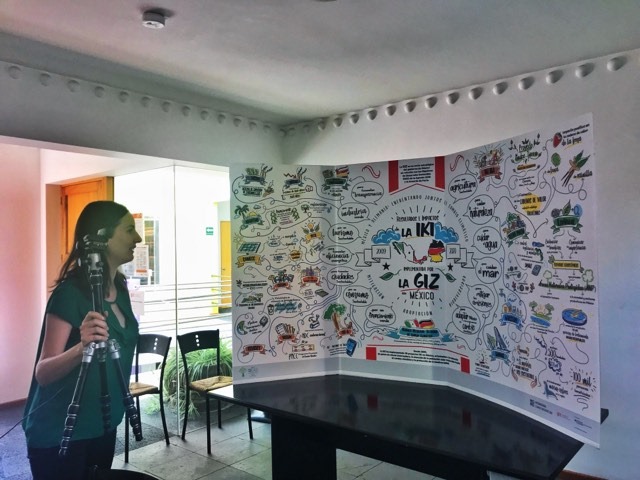
 

Credits: GIZ. Claudia Kirschning (GIZ) presents an infographic of the IKI projects implemented by GIZ.


In the second part of the workshop, IKI project leaders divided into working groups to exchange knowledge and reach agreements that will help support an increased synergy among the different initiatives. The topics covered were: private sector, sustainable urban development, agriculture, adaptation, biodiversity/REDD+, financing, transparency/MRV, and  mitigation/energy.

After the plenary session, Jasmin Fraatz thanked attendees for participating in this new digital format and announced that a face-to-face version of the event would take place in the future.

More information regarding the first, second and third workshops.
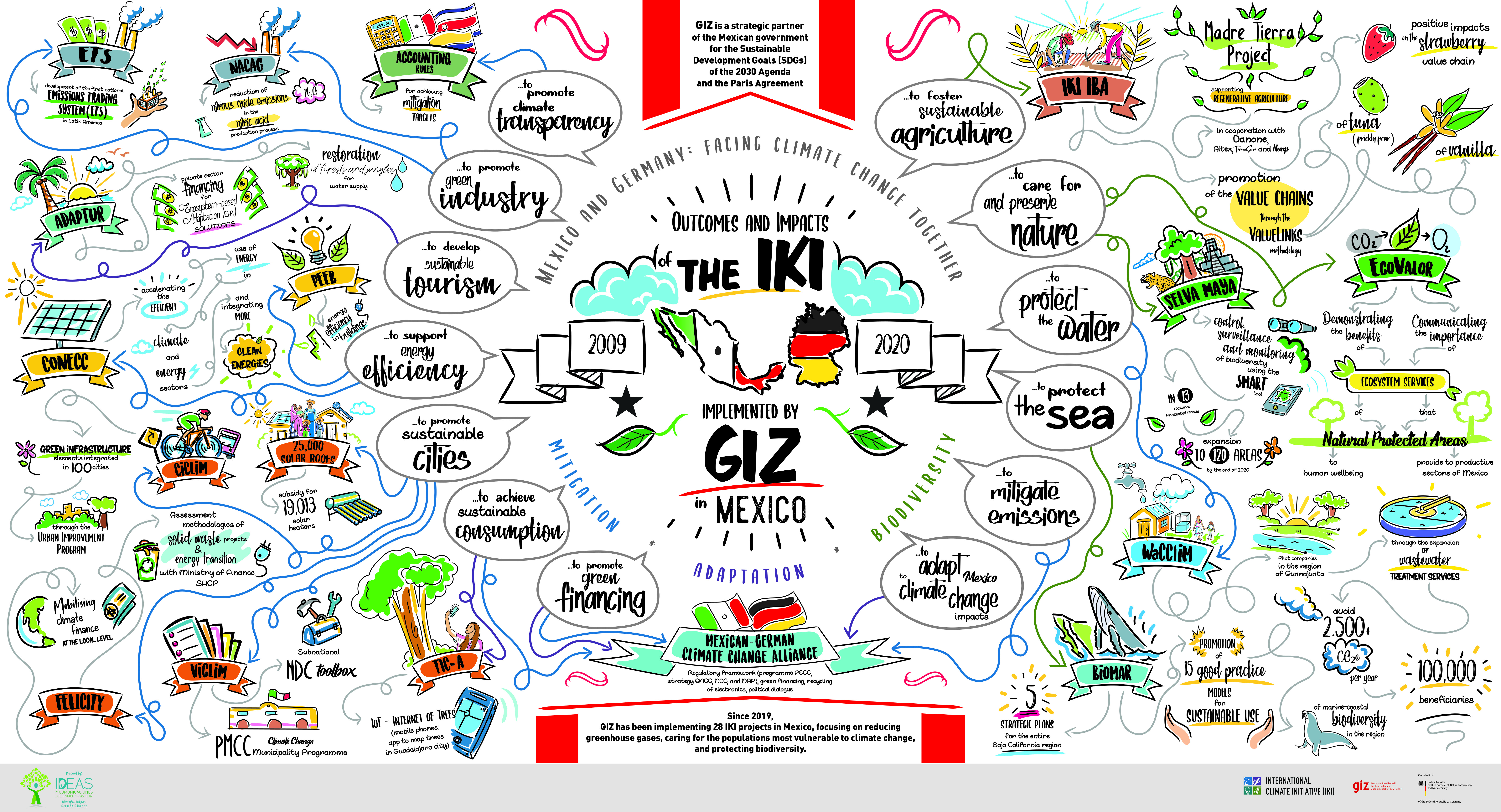
 

Credits: GIZ. IKI projects implemented by GIZ in Mexico.

The Ministry of Environment of Mexico (SEMARNAT) has signed a commitment to reduce N2O emissions from nitric acid production to a minimum, through implementing appropriate political instruments by the end of 2024.

Nitric acid is used worldwide as a raw product for the manufacturing of artificial fertilizers and explosives. During the manufacturing process, significant amounts of N2O are emitted. This gas is one of the most climate-damaging; 265 times more harmful than CO2. All nitric acid producing plants located in Mexico have an impact on the climate equivalent to the emissions of 200,000 passenger vehicles driven for one year. With a goal to substantially reduce N2O emissions from the production of Nitric Acid worldwide, the Nitric Acid Climate Action Group (NACAG) was initiated by the German Federal Ministry for the Environment, Nature Conservation, and Nuclear Safety; funded through the International Climate Initiative.

Minister Svenja Schulze, “German Federal minister of Environment commended this saying, “We are very glad to welcome Mexico as the first Latin American Country that commits to a climate friendlier nitric acid production. With this important milestone, NACAG gets closer to its goal of transforming a whole sector”.

Following this decision they have identified three nitric acid production plants in Mexico that can switch to climate-friendly operation with funds from the Nitric Acid Climate Action Group (NACAG). A total of EUR 4 to 5 million is available for the conversion to N2O abatement technology, capable of reducing up to 98% of the N2O emissions of a plant.

Mexico’s commitment represents an important milestone in NACAG’s achievements in the Latin American Region. It also contributes to Mexico’s efforts towards fulfilling the climate targets set in the framework of the Paris Agreement.

The Mexican government has established a social promise of providing Mexican citizens with more equality and justice. At the same time, the country has embarked on a transition to adopt sources of clean energy, which will be decisive for reducing the carbon footprint of the Mexican energy sector and enabling an ample spectrum of social and economic opportunities for the country.

In a fruitful partnership, the Ministry of the Environment and Natural Resources (SEMARNAT) and the Deutsche Gesellschaft für Internationale Zusammenarbeit (GIZ) GmbH, in collaboration with the Potsdam Institute for Advanced Sustainability Studies (IASS), have prepared a detailed evaluation that examines the important co-benefits of renewables and energy efficiency in Mexico’s energy transition, as well as options for more adequate policies in order to deliver these benefits to the Mexican people. The report is based on four case studies that took place in Baja California Sur, Mexico City, Oaxaca, and the Yucatan, which provided a significant orientation on topics of evaluation and co-benefits, and how to guarantee political relevance for the social and economic opportunities addressed.

Research partners Ithaca Environmental, as well as the Climate Initiative of Mexico (ICM), were also present during the technical implementation. This report of the Co-Benefits of Mexico has been facilitated by the Energy and Climate Change Policy Convergence (CONECC) project of GIZ and with the financial support of the International Climate Initiative (IKI).

Mexico, alongside 187 other parties to this date, ratified the Paris Agreement to tackle climate change and provide opportunities for current and future generations to prosper. With this study, we look to contribute to these international efforts, offering a scientific basis and harnessing the social and economic co-benefits in this energy transition. Building an energy system with low carbon emissions, while facilitating a fair transition, will enable successful climate action for the planet and the Mexican people.

We want to inspire readers to participate in the important debate regarding a just and sustainable energy future in Mexico.


If you would like more information, contact: gianna-maria.pedot@giz.de

Within the framework of the project Biodiversity and Sustainable Agrosilvopastoralist Livestock Landscapes (BioPaSOS), more than 1,200 livestock breeders – men and women from Jalisco, Chiapas, and Campeche in Mexico – are being trained to implement silvopastoral systems on their farms, as well as good livestock practices that can contribute to the conservation of biodiversity and the mitigation of greenhouse gases (GHGs), thus increasing their ability to adapt to climate change.

Upon implementing these technologies, they’ve been able to overcome food shortages for their livestock in dry season, increase productivity, better manage the pastures, improve the health of their animals, and – in some cases – reduce the use of agrochemicals. What’s more, by conserving and improving the management of trees on their farms, they’ve obtained benefits such as firewood, timber, fence posts, and fruits.

All of this knowledge has been transmitted to farming families through the 68 Farmer Field Schools (FFSs) developed by the project Biodiversity and Sustainable Agrosilvopastoralist Livestock Landscapes, known as BioPaSOS, alongside local partners and in coordination with the Agriculture and Environment Ministries in each territory of intervention.

“BioPaSOS has provided us with the tools to adapt. We are now putting into practice what they’ve taught us on the farm, and we can see better results in our production, as well as economic savings,” asserted Laura Madera, a producer from Jalisco.

The main practices developed during the FFSs are the establishment of hedges, tree-planting in pastures, the establishment of cut grasses, multinutrient blocs, silage, management of fodder crops, the use of biodigesters, and the production of sulphate and calcium products. They’ve also been sensitized to conserving biodiversity to increase the resilience and adaptation of livestock production to climate change; for example, the trees help to capture GHG, protect water sources, provide habitat, and increase the connectivity of the landscape, which helps to maintain the viability of plants and animal communities on farming landscapes.

Héctor Caamal, a farmer from Campeche, says the FFS changed his belief that in order to rear livestock, it was necessary to get rid of trees. He now practices a very different kind of livestock farming, keeping more animals in a smaller area – which allows the trees to grow – and implementing positive livestock practices.

BioPaSOS is implemented by the Tropical Agricultural Research and Higher Education Center (CATIE), with the support of the Inter-American Institute for Cooperation on Agriculture (IICA), in coordination with the National Commission for the Knowledge and Use of Biodiversity (CONABIO) and the Ministry of Agriculture and Rural Development (SADER), with financing from the International Climate Initiative (IKI).

The Deutsche Gesellschaft für Internationale Zusammenarbeit (GIZ) GmbH, at the request of Germany’s Federal Ministry for the Environment, Nature Conservation and Nuclear Safety (BMU), co-organized an event about good international verification processes for greenhouse gas (GHG) emissions within the framework of the Emissions Trading System (ETS). This workshop took place within the project “Preparation of an Emissions Trading System in Mexico” (SiCEM) alongside the “México Economía Limpia” alliance from Stanford University and USAID. The course included the participation of experts in monitoring, reporting, and verification (MRV) from the European Union and California; they shared some of their challenges and learning from years of experience within their respective jurisdictions.

The course’s inauguration was presided by Professor Julio Trujillo (Undersecretary of Development and Environmental Regulation at SEMARNAT), Yutsil Sanginés Sayavedra (General Director of Climate Change Policy at SEMARNAT), Jasmin Fraatz (Coordinator of the GIZ Climate Change Cluster), Blas L. Pérez-Henríquez (Director of the “México Economía Limpia 2050” alliance) and Rosario Miranda (Assistant Director of the Certifying Agencies at EMA, the Mexican Accreditation Body). They all highlighted the importance of international cooperation in order to share good practices from countries and programs with experience in GHG verification.

The course took place from the 27th to the 31st of January 2020 and brought together participants from the Certification, Verification, and Validation Agencies (OC-VV), the Mexican Accreditation Body (EMA), the Federal Bureau of Environmental Protection (PROFEPA), and the Ministry of the Environment and Natural Resources (SEMARNAT), among others. During five days of training, experts from the California Air Resources Board (CARB) and Verico SCE updated the participants on topics such as accreditation of verifying agencies, and the revision and monitoring of verifications. Likewise, they placed emphasis on the verification processes of sectors such as energy, cement, and steel.

With this kind of training, it is expected that key actors for the Pilot Program for the Emissions Trading System – such as these verifiers – develop the skills for solid verification of GHG emissions at the participating installations.


Presentations at the Event (in Spanish)
Day 1

1 European Union Accreditation Process

1_2_Comparisons between Accreditation Systems

1_ Accreditation of GHG Verification Agencies: Accreditation processes in the USA and Canada

2 Accreditation: Qualification Criteria for Qualification Verifiers: EU functioning

3 Monitoring of GHG 1. Basic concepts and EU Regulations

3_Monitoring of Greenhouse Gases Comparative Monitoring Plan

3_ Reporting Protocol for the Voluntary Report Program

4 Monitoring of GEI 1: Activity details, Calculation and Uncertainty Factors

4_Monitoring of Greenhouse Gas Effects. Addressing Uncertainties

4_Reporting Protocol for the Voluntary Report Program

5 Verification Criteria. Concept and Materiality

5_ Materiality Verification Criteria

Verico SCE. Presentation of the Cooperative

Accreditation of GHG Verification Agencies: Accreditation processes in the USA and Canada

Session 3. Reporting Protocol for the Voluntary Report Program

Session 4. Reporting Protocol for the Voluntary Report Program


Day 2

6_10_ Accreditation of GHG Verification Organisms: Accreditation processes in the USA and Canada

6_ Verification Process. Contract revision

7_ Verification Process. Strategic Analysis and Roles

7_ Verification Process. Strategic Analysis and CoI 

7_ Verification Process. Conflict of interest

8 Verification Process. Risk Analysis and Verification Plan. Verification Process

9_Verifier Tools

9_ Verification Plan and Risk Analysis

9_USA-Canada Risks. Government Risk Evaluation in Alberta, Canada

10 GIZ Verification Process. Findings and Report

10_ Verification Process. Verification Report. Non-Compliances Treatment

11_Case Study

Session 5 – Accreditation of GHG Verification Agencies. Accreditation processes in the USA and Canada

Session 6 – Verification Process. Strategic Analysis and CoI

Session 9 – Government Risk Evaluation in Alberta, Canada