

Author: IKI Alliance
If 10% of the hotels in Mexico reduced their energy consumption by 30%, the CO2 mitigation potential that could be achieved would be 287 thousand tons of CO2 eq. per year. This and other data can be found in the Guide to Energy Efficiency in the Design, Construction and Operation of Hotels in Warm Climates, which illustrates energy efficiency measures, cost-benefit data, and information on the importance of promoting energy efficiency in the hotel sector, as well as business models and financing options.
The guide was produced within the framework of the PEEB and FELICITY global programs of the Deutsche Gesellschaft für Internationale Zusammenarbeit (GIZ) GmbH in conjunction with the Mexican Ministry of Environment and Natural Resources.
It is possible to achieve a 30% reduction in energy in a beach hotel, with a return on investment of 2.5 years, using passive and active energy efficiency measures. The Guide to Energy Efficiency in the Design, Construction and Operation of Hotels in Warm Climates uses practical examples to illustrate the energy efficiency and renewable energy measures that can be used, with even zero-energy hotels possible.
This guide was presented during the virtual forum “Experiences, Models and Alternatives of Energy Efficiency in Accommodation Establishments”, which served as a space to publicize the economic and environmental benefits of implementing the environmental sector’s energy optimization model for lodging establishments.
Representatives of the Ministry of Environment (SEMARNAT), Ministry of Tourism (SECTUR), National Commission for the Efficient Use of Energy (CONUEE), GIZ México, Global ABC, EDGE, Green Key, Grupo Posadas and Hoteles Misión participated in the Forum.
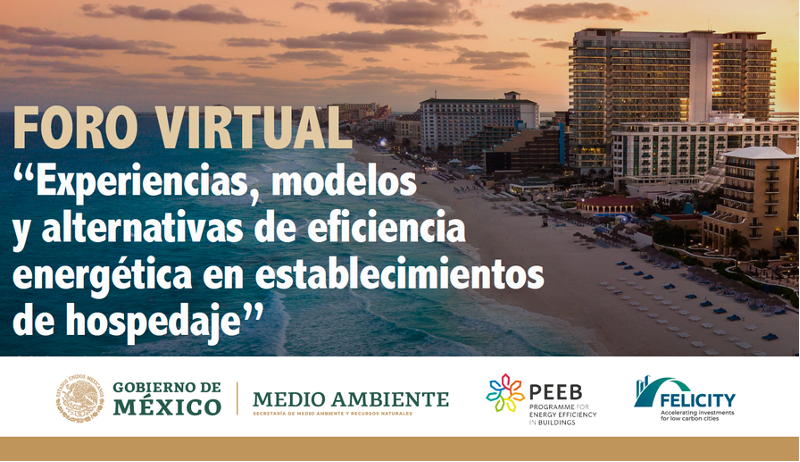
The event was broadcast on digital platforms such as Cisco Webex and Facebook, reaching more than 500 attendees in total and more than 15,000 reproductions on the social network.
The guide was developed within the framework of two global programs: the Programme for Energy Efficiency in Buildings (PEEB), which combines the technical knowledge of GIZ with that of the Agence de l’Environnement et de la Maitrise de l’Energie (ADEME) and the Financing Energy for Low-carbon Investment – Cities Advisory Facility (FELICITY) financed in collaboration with the European Investment Bank (EIB). This collaboration is an example for both projects supported by the International Climate Initiative (IKI) of Germany’s Federal Ministry for the Environment, Nature Conservation and Nuclear Safety (BMU) and implemented by the Deutsche Gesellschaft für Internationale Zusammenarbeit (GIZ) GmbH.
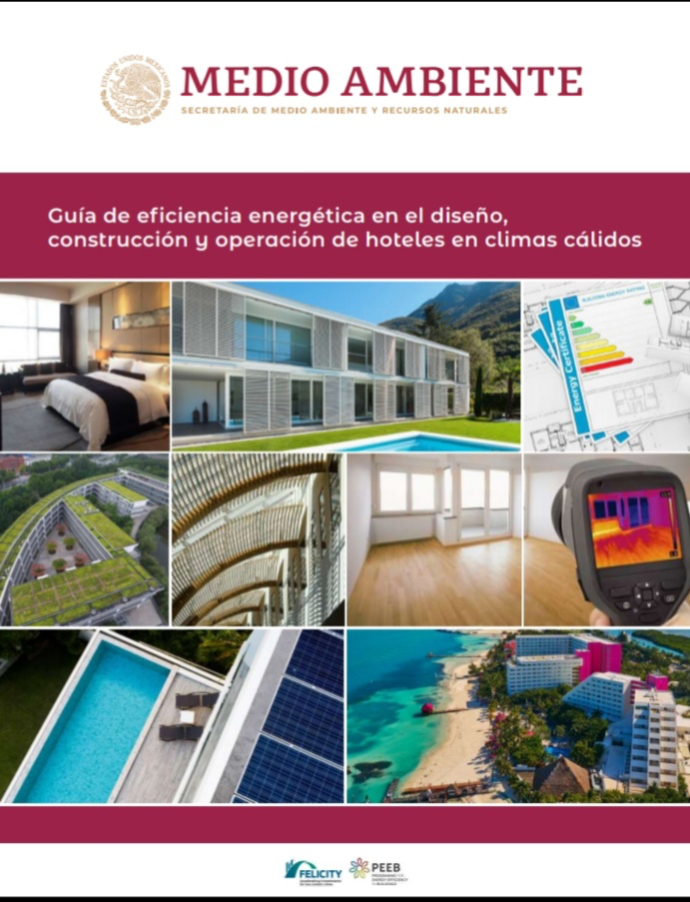
The guide is available for download on the SEMARNAT page: https://www.gob.mx/cms/uploads/attachment/file/565858/Gu_a_de_eficiencia_energetica_hoteles__comprimida_.pdf
Technological innovation in renewable energies and energy efficiency is key not only to promote climate action but also to promote economic reactivation. In coordination with the State of Querétaro and the Deutsche Gesellschaft für Internationale Zusammenarbeit (GIZ) GmbH through the Project Enhancing the Coherence of Climate and Energy Policies in Mexico (CONECC), the objective of the workshop was to lay the foundations for the preparation of the first call for projects at the Hub, through the identification of challenges and specific technological challenges of the state energy sector (renewable energy and energy efficiency), and the definition of criteria to choose the projects of innovation that will be chosen to access the services of the Hub.
The workshop lasted two days and was attended by 17 people from different key sectors: government, academia, companies, startups, and specialists in the field, which together are part of the triple helix of technological innovation.
Summary of the first and second day of the workshop
On the first day of the workshop, Germán Borja, from the Ministry of Sustainable Development of the State of Querétaro (SEDESU) mentioned that “the main goal of the workshop was to align our ideals and be able to collaborate together” at the Hub. Under this premise, the challenges and possibilities of the energy sector of Querétaro were identified, taking into account the difficulties that, in the context of economic recovery post-COVID-19, the local innovation ecosystem has presented. Part of the work on the first day was to map the actors to analyze the socio-environmental system and the possibilities of the projects in the state energy context. The challenges and potential solutions for the first call for projects were also defined. The participants discussed and defined a strategic and shared vision for the future of the Hub:
“The state of Querétaro promotes synergy among stakeholders, through technological development in digitalization and smart grids that allow sustainable socio-economic development to guarantee the safety and efficiency of clean energy. The Hub is a benchmark for progress, certainty, and profitability in clean energy for the State of Querétaro.”
On the second day of the workshop, the challenges posed by the actors were reviewed, in order to align them with the Hub’s objectives and find innovative solutions based on new technologies such as smart grids, and energy efficiency, among others. Additionally, the group of participants co-designed, through a participatory exercise, a set of criteria to assess innovation projects within the framework of the Hub’s first call. A very relevant agreement was that the selected projects seek to incorporate a strong component of social and environmental adoption in the development of the technologies promoted by the Hub.
Esta semana se llevó acabo el "Taller de identificación de retos y desafíos para el Hub de Querétaro". 💡👩💻👨💻Hubo un acercamiento entre diferentes actores 🤝 y se resaltó la importancia de la innovación 🧑🔬en la transición energética para la reactivación económica sustentable💹🌿. pic.twitter.com/46DRV4OCPg
— Conecc_Mx (@Conecc_Mx) August 7, 2020
As next steps, the Working Group will take into account the results of this dialogue to discuss and prepare a call for proposals for the Querétaro Hub in the weeks to come, focused on proposals for innovative projects with a degree of medium technological maturity and that strengthen the resilience capacity of SMEs and startups in Querétaro in the face of the COVID pandemic. More information coming soon!

The GIZ project “Preparation of an ETS in Mexico” (SiCEM) provides support to the Ministry of Environment and Natural Resources (SEMARNAT) in the continuous development of capacity-building activities for relevant actors and decision-makers from public and private sectors. The project, which began on January 1, 2020, is carried out within the framework of the Emissions Trading System (ETS) Test Program in Mexico.
In this context, the 2020 ETS Academy was held for the second consecutive year. On this occasion, it was successfully carried out virtually, and focused on the implementation aspects of the Test Program. The course was convened by SEMARNAT and developed with the support of the World Bank’s Partnership for Market Readiness (PMR), the International Carbon Action Partnership (ICAP) and GIZ Mexico.
Between August 18 and September 10, productive space for exchange and networking was generated among around 60 course participants. During these four weeks, learning was strengthened with presentations of the lessons learned, merits and challenges in the implementation of an ETS by national and international experts (China, Quebec, California, European Union, etc.), as well as the use of innovative digital tools and images that captured the key points discussed during the sessions.
Finally, there were two sessions open to the public, attended by Mr. James Grabert, Director of Mitigation of the United Nations Framework Convention for Climate Change (UNFCCC), as well as an exchange session between Latin American countries on carbon price instruments.

Photographic Archive 2020 ETS Academy © GIZ
Week 1. ETS Architecture, Pilots from Mexico and the World
The first week set the stage for subsequent sessions, introducing the concept of carbon pricing instruments and the opportunities presented by the ETS in order to meet the NDC mitigation climate targets based on the Paris Agreement. Although the international experience has shown that it is a cost-effective instrument, its effective implementation requires clear regulatory frameworks, a national policy that responds to international commitments, and close communication with the actors involved in the process.
Jurisdictions such as China, Quebec, and Spain (as part of the European ETS) shared their ETS experiences in the early phases. They stressed the importance of having a strong regulatory and political framework, creating opportunities for dialogue with the regulated sectors and ensuring the quality and robustness of emissions data. In recent years, Mexico has implemented a legal and institutional framework on the matter based on the reform of the General Law on Climate Change in 2018 and the publication of the Agreement establishing the preliminary bases of the ETS Test Program, in which the figure of the Advisory Committee is also created as a space for dialogue and feedback. It also has a robust MRV framework, reflected in the National Emissions Registry (RENE).
Week 2. Allocation and Market Dynamics. What are the Options?
During the second week, the methods to allocate Emission Allowances (DEM) were discussed. Each jurisdiction chose a method (or combination of methods) to use based on national priorities and ETS objectives, among which the following stand out: incentivizing abatement measures, increasing revenue at the government level, protecting the competitiveness of regulated facilities or manage a gradual transition to an ETS. In the case of Mexico, the Trial Program will start a free scheme based on historical emissions per installation in order to facilitate the transition to the Formal Phase of the ETS; later on, the implementation of a percentage of allocations through auctions is envisaged.
Once DEMs are assigned, they can be traded on the secondary market. In the sessions, actors involved in DEM trading in the European ETS covered the different alternatives that exist for this trade, such as exchanges or stock exchanges, or bilaterally through a mechanism known as over-the-counter, as well as looking at the relevant difference that exists between regulated carbon markets (a public policy instrument with a defined legal framework and jurisdiction to reduce GHG emissions) and voluntary ones (a decentralized initiative to promote the reduction of emissions and facilitate the participation of more actors in mitigation activities).

Photographic Archive 2020 ETS Academy © GIZ
Week 3. Monitoring, Reporting and Verification Systems (MRV): ETS Challenges and Successes
An effective ETS requires a robust MRV scheme, as this allows designing the top of the ETS and making a better DEM allocation. Also, it ensures environmental integrity and enables compliance monitoring of the covered sectors. It was highlighted that it is crucial to incentivize compliance in an SCE, since otherwise, there is a risk of distorting competition between regulated entities. Jurisdictions such as California, Germany, the Netherlands, and China, shared the mechanisms used to strengthen compliance in their jurisdictions, such as the involvement of the regulated from the early stages of the process so that they are well aware of their obligation, the constant and proactive communication of obligations, listening to feedback, even administrative and economic sanctions.
Week 4. ETS Social and Environmental Benefits and Progress in Latin America. Where are we, and where are we going as a region?
During the last week, the 2020 ETS Academy addressed two topics: offset mechanisms and carbon price instruments in Latin America.
Regarding the first, the ETS includes mechanisms to encourage mitigation actions in non-regulated sectors under the offsets scheme. These contribute to the sustainable development of other sectors and actors indirectly linked to the ETS. Similarly, they allow cost reduction by improving the efficiency of the ETS. With a view to the Operational Phase, a global overview of these mechanisms was presented, as well as an exploration of the possibility of generating offsets for sectors such as forestry, livestock and agriculture, and transportation, within the Mexican context.
On the closing, the 2020 ETS Academy culminated with the exchange of experiences in the Latin American region. The participants had the opportunity to learn about the different advances in the area based on carbon prices. In this regard, countries such as Chile, Peru, and Colombia have implemented a tax on carbon or fossil fuels, while Brazil is analyzing the most cost-effective instrument for the country. Mexico is positioned as the first country in the region to have both a carbon tax and an ETS, so it will be of great interest to learn about their valuable experiences during the design of the ETS and the implementation of the Test Program.

Participants and speakers at the 2020 ETS Academy © GIZ
For more information on this topic, please contact us at: Comercio.Emisiones-MX@giz.de
The National Emissions Registry (RENE) is a public policy instrument derived from the General Law on Climate Change (LGCC) in 2012, with the aim of compiling information on direct and indirect emissions of greenhouse gases and compound emissions (CyGEI) generated by the fixed and mobile sources of the different productive sectors across the country, which is used to trace climate policies in Mexico.
Annually, Establishments Subject to Reporting (ESR) regulated by the RENE Regulation, report their CyGEI emissions to the Ministry of Environment and Natural Resources (SEMARNAT). The reports must be verified every 3 years by a Certification Body for the Verification and Validation of GHG Emissions (OC-VV-GEI) accredited by the Mexican Accreditation Entity (EMA) and approved by the Federal Attorney for Environmental Protection (PROFEPA), which certifies the relevance, integrity, consistency, transparency and precision of the information they contain.
The recent Emissions Trading System (ETS) Test Program in Mexico, effective as of January 1, 2020, is integrated with the information reported in the RENE and establishes the obligation of regulated facilities in the preliminary bases of the ETS, to present positive verification opinion on an annual basis only for its direct carbon dioxide emissions, in accordance with the procedure and criteria provided in the RENE Regulations.
In order to continue strengthening and creating OC-VV-GHG capacities in Mexico, SEMARNAT, in collaboration with the Deutsche Gesellschaft für Internationale Zusammenarbeit (GIZ) GmbH through the project “Preparation of an Emissions Trading System in Mexico ”(SiCEM), organized the series of online seminars “Methodological Aspects for GHG Verification within the Framework of the report to the National Emissions Registry and the Emissions Trading System for Mexico”, with the participation of the EMA, PROFEPA, and 16 OC-VV-GEIs.
The seminars were held on August 24, 27 and 31, 2020 with the purpose of reinforcing the knowledge of the OC-VV-GHGs on the methodological aspects for the development of a risk analysis, the preparation and planning of sampling plans, and the calculation of materiality in the GHG emissions verification process based on the CyGEI Emissions Verification Criteria issued by SEMARNAT. In this way, it seeks to strengthen the verification process to provide reliability and transparency to the RENE and the ETS.
Seminar 1: Monday, August 24, 2020. Development of Risk Analysis.
Seminar 2: Thursday, August 27, 2020. Data Sampling and Materiality – Regulation, Concepts and Calculation.
- Presentation: Theoretical Aspects on Sampling and Materiality
- Guide to Sampling and Materiality
- Presentation: Practical Examples for the Calculation of Materiality
Seminar 3: Monday, August 31, 2020. Materiality Calculation and Application of Sampling Methodologies.