This guide is a tool that establishes viable financing alternatives for subnational governments to develop a financial architecture that contributes to the implementation of their climate change policy.
For several years, states in Mexico have made efforts in the construction of climate policies that support the implementation of mitigation measures and adaptation to climate change in their territories. One of the biggest challenges they have faced at the time of implementing the measures is to obtain resources, which is why access to climate finance is fundamental.
This guide to climate financing for states provides guidance and offers a series of answers to questions that states often ask themselves when they seek to understand what climate financing is, for example including the following:
What is the importance of climate finance for compliance with its policies in this area?
What are the sources of financing?
Where can the resources come from to finance climate change measures?
How can federative entities build their own financial resources without relying on a third party?
This guide establishes clear and precise steps to follow regarding the most viable financing alternatives that exist in the country in terms of experience, faculties and costs. In the same way, it intends to be an instrument on which those responsible for public policies in the matter can rely on when making decisions that involve getting access to public resources that they can provide as a source of financing.
Within the range of financing options detected for the states, the guide explains in a specific way the development and route of implementation of two financial vehicles at the state level:
The Transverse Annexes in the Budget of State Expenditures (PEE, for its Spanish acronym)
Environmental or Climate Change Funds.
This tool was developed by the Mexican-German Climate Change Alliance, a project implemented by Deutsche Gesellschaft für Internationale Zusammenarbeit (GIZ) GmbH and was presented for the first time at the fourth regional workshop on “Strengthening Subnational Capacities and their Contributions to the Nationally Determined Contribution (NDC)” on January 25, 2018.
The EcoValor Mexico Project (www.ecovalor.mx) was implemented between November 2013 and March 2018 and was characterized by almost 5 years of close collaboration between the National Commission of Natural Protected Areas (CONANP) and the Deutsche Gesellschaft für Internationale Zusammenarbeit (GIZ) GmbH.
What are the results of our joint work?
Among others, the following results have been achieved:
• Integrating an innovative approach that strengthens biodiversity conservation efforts: Mexico has been a successful pioneer in integrating the SE of natural protected areas (ANP, for its Spanish acronym) into policies to strengthen the CONANP and the management of ANP, such as Management Programs and Technical Opinions on Environmental Impacts as a tool for strategic financing.
• Strengthening the technical and management capacities to work with the approach.
• Communicating in a differentiated way the importance of biodiversity and ecosystems that Mexico conserves with great effort.
• Positioning the ANPs in various spaces for reviewing public policies (for example, Inter-institutional Technical Group of INEGI and in the Inter-Institutional Group for the Assessment of Ecosystem Services of SEMARNAT)
• Strengthening the strategic focus of financing for ANP, seeking alternatives, such as collaboration with the private sector in a sustainable manner, identifying risks and opportunities.
• ANPs are directly contributing to key sectors of the country’s economy: for being strategic zones for the forestry sector, they are a strategic asset for the agricultural sector, they are an ally in the protection against extreme climatic phenomena, and they are decisive zones for the fishing in Mexico.
• The Protected Areas of Cozumel Island are reducing the vulnerability of the population, and tourism appreciates its attributes in millions of pesos.
• The Cabo Pulmo National Park is widely recognized and valued by the population of Mexico and the world for being the “Aquarium of the World” of regional and global importance.
• The Iztaccíhuatl-Popocatépetl National Park provides drinking water for 13 million people and offers local income opportunities thanks to its woods
• The ANPs of the Sierra Madre Complex of Chiapas contribute to infiltrate water worth 16,000 million pesos (around 800 million USD) and provide opportunities for local coffee production.
• The ANPs of the Términos y Pantanos de Centla Lagoon Complex provide protection against storms and represent an important biological filter for the region.
• The approach allows generating a common language with the private sector (natural capital), where terms such as “biodiversity or ecosystem services” can be part of a technical language and are sometimes less common.
On May 23rd, 2018, the closing of the EcoValor Mexico project was celebrated, with representatives of CONANP, GIZ and strategic allies.
EcoValor Mexico was implemented on behalf of the German Federal Ministry for the Environment, Nature Conservation and Nuclear Safety (BMU), through the German Cooperation for Sustainable Development – Deutsche Gesellschaft für Internationale Zusammenarbeit (GIZ) GmbH, within the framework of the International Climate Initiative (IKI). The implementing partner in Mexico was the National Commission of Natural Protected Areas (CONANP).
With the entry into force of the Paris Agreement in 2015, the Parties undertook to comply with their Nationally Determined Contributions (NDC) to the United Nations Framework Convention on Climate Change (UNFCCC). Mexico ratified its NDC in 2016, which integrates both mitigation commitments of greenhouse gases and adaptation to climate change for the period 2020-2030.
To achieve the commitments framed in the NDC, states and municipalities have a key role, because their actions directly impact their populations and the causes and effects of climate change within their territories. This capsule seeks to guide climate actors at subnational level and enable them to identify and develop measures within their jurisdictions that contribute to the achievement of the NDC, as well as inviting them to share their experiences.
The blog “IKI Alliance Mexico” was launched on 8th of March 2018 and reports on activities and impacts of the 39 projects of the International Climate Initiative (IKI) in Mexico, funded by the German Federal Ministry for the Environment, Nature Conservation, Building and Nuclear Safety (BMUB).
Currently, more than 15 organizations are implementing 39 IKI projects in Mexico in the four IKI funding areas: mitigation, adaptation, REDD + and biodiversity. As the IKI interface project, the “Mexican-German Climate Change Alliance” (a bilateral IKI project implemented by Deutsche Gesellschaft für Internationale Zusammenarbeit (GIZ) GmbH) manages this new blog, which informs about news and events of IKI projects as well as current developments in climate and biodiversity policies in Mexico. With this blog and the new newsletter, exchange and synergies among IKI projects in Mexico are sought to be promoted.
In addition, the second networking workshop will be organized in April 2018, addressed to IKI projects, their Mexican counterparts, the IKI and the BMUB. The workshop will take a thematic approach facilitating exchange and synergies among IKI projects. Its objectives are to define the contributions of IKI projects to the NDC and Mexico¨s National Biodiversity Strategy and Action Plan as well as to identify synergies among the contributions of the IKI projects to the NDC and the 2030 Agenda. In addition, tools and lessons learned will be exchanged and further synergies among IKI projects will be identified by means of three key themes (finance, transparency and mainstreaming). The workshop takes place on 12th and 13th of April 2018 in Mexico City (closed event).
The Center for the Integration of Biodiversity of SAGARPA sets an important international precedent in favor of compliance with the agreements reached at the 13th Conference of the Parties to the Convention on Biological Diversity and the Sustainable Development Goals of the United Nations. The Center is a first step to integrate biodiversity into the productive activities of the Mexican food sector, which is the 12th largest food producer and 10th exporter in the world, and which has one of the most biodiverse regions on the planet.
In addition, the Center is one of the first results of the project “Mainstreaming Biodiversity into the Mexican Agricultural Sector IKI-IBA”, which began at the end of 2016 and aims to integrate the values of biological diversity and ecosystems into the decision and planning instruments of public and private key players in the sector.
The inauguration of the Biodiversity Integration Center took place on March 7th in Mexico City in the facilities of the Ministry of Agriculture, Livestock, Rural Development, Fisheries and Food (SAGARPA) with the presence of the Undersecretary of Agriculture, Jorge Armando Narváez Narváez, Dr. José Sarukhán Kermez, National Coordinator of the National Commission for the Knowledge and Use of Biodiversity (CONABIO), Edda Veturia Fernández Luiselli, General Director of the Primary Sector and Renewable Natural Resources of the Ministry of Environment and Natural Resources (SEMARNAT), Martin Nissen, Agricultural Affairs Adviser of the German Embassy in Mexico, and Harald Lossack, Coordinator of the Cluster of Biodiversity of GIZ in Mexico.
Undersecretary Narváez highlighted the importance of inter-institutional collaboration to advance the conservation and sustainable use of biodiversity in agricultural activities, reducing the negative impacts of these activities on ecosystems and considering the new circumstances imposed by climate change. In this same sense, he also emphasized the challenge that the country has to guarantee food security in the 21 million hectares that are currently dedicated to agricultural activity, through innovation, technification and training of producers. Finally, he mentioned the importance of the cooperation and support of GIZ to advance on the biodiversity agenda in the sector and the promotion of inter-institutional dialogue.
For his part, Mr. Nissen expressed the recognition of the German government regarding the need to achieve fundamental changes in the management of natural resources to ensure the feeding of a growing population and the sustainability of environmental services. He stressed that Mexico is a strategic country for Germany in matters of environment, biodiversity and climate change, as well as the willingness of the Mexican government to advance on these agendas. He also mentioned the great importance of installing a geographic information system developed by SAGARPA with the collaboration of GIZ and CONABIO, aimed at strengthening agricultural planning with criteria for biodiversity conservation.
The project is executed by SAGARPA and the Deutsche Gesellschaft für Internationale Zusammenarbeit (GIZ) GmbH, on behalf of the Federal Ministry for the Environment, Nature Conservation and Nuclear Safety (BMU) and is funded by the International Climate Initiative (IKI, for its acronym in German).
The partners of the project are the Ministry of Environment and Natural Resources (SEMARNAT), the National Commission for the Knowledge and Use of Biodiversity (CONABIO), the Mexican Agency for International Development Cooperation (AMEXCID), the United Nations Program United for the Environment (UN Environment) and the United Nations Organization for Agriculture and Food (FAO).
From 2015 until 2018, the newsletter climate.blue was published (in German language). Moreover, from 2015 to 2017 the newsletter “Biodiv-News aus Mexiko” (biodiversity news from Mexico) was published in German.
Since the beginning of 2018, the climate.blue newsletter converted into the new IKI Alliance Mexico newsletter. It covers both climate and biodversity IKI projects and topics and is published in Spanish and English to allow international subscribers to keep informed about IKI news in Mexico.
The IKI Alliance Mexico Newsletter now covers the entire project portfolio of the International Climate Initiative (IKI) in Mexico, financed by the German Federal Ministry for the Environment, Nature Conservation and Nuclear Safety (BMU). Currently, more than fifteen organizations are implementing approximately 40 IKI projects in Mexico. This newsletter is administered by the “Mexican–German Climate Change Alliance” (a bilateral IKI project) and informs you every three months about relevant news and events of Mexican IKI projects as well as new developments in Mexican climate and biodiversity policy.
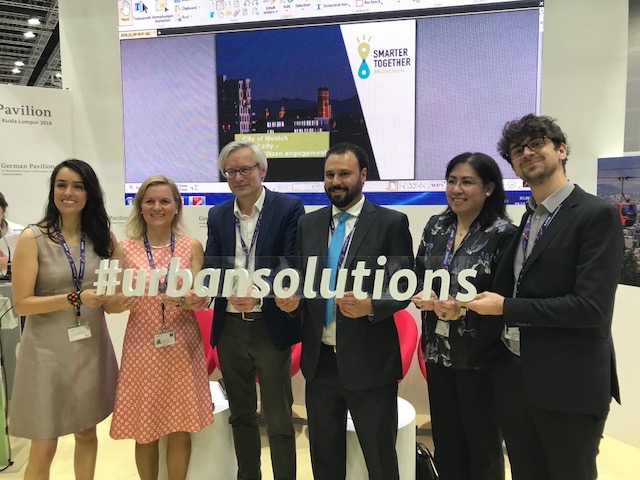
The World Urban Forum 9 (WUF9), took place this February 2018 in Kuala Lumpur, Malaysia. This year’s thematic focus addressed the implementation of the New Urban Agenda (NUA) adopted at the Habitat III Conference, as well as the achievement of the Sustainable Development Goals (SDG) and the Nationally Determined Contributions (NDC) at the local level. The WUF9 made Information and Communication Technologies (ICT) and “Smart City” approaches evident as key enablers for achieving sustainable solutions. Noted during the special session “Smart Cities and the Growing Role of Frontier Technologies in Sustainable Urbanization”, UN Secretary-General’s establishment of a working group on the topic at the Chief Executives Board for Coordination, underlines its increasing relevance.
Seeking to contribute to the discussion on how to actively shape this digital transformation to indeed achieve sustainable and inclusive Smart Cities, the Federal Ministry for the Environment, Nature Conservation, Building and Nuclear Safety (BMUB) co-hosted with GIZ’s Global Program “ICT-based Adaptation to Climate Change in Cities” (ICT-A) a side event, which looked behind the scenes at the governance, capacities and viability needed by cities. BMUB’s State Secretary, Gunther Adler, opened the event, stressing the need to internationally disseminate and enrich the dialogue to develop shared normative values. During the panel moderated by Andreas Proksch, GIZ’s Head of the Department Sector and Global Programs (GloBe), a representative of the Mayor from the City of Kochi explained India’s plan to achieve 100 Smart Cities, while ICT-A’s Partner City, Guadalajara, Mexico, presented a compilation of initiatives and platforms aimed at enhancing transparency and citizen engagement, increase efficiency of administrative processes and adapt to climate change. Furthermore, the City of Munich contributed to the dialogue from its expertise, sharing German experiences around smart city labs.
Without doubt, digitally enhanced public services have great potential to also increase climate resilience in cities, providing platforms for inclusion, improving the dialog between city administrations and citizens. However, tendencies to prioritize technology ahead of citizen’s perspectives jeopardize the service’s sustainability and scalability. Believing that putting citizens – not technology – at the center of public services design is the only way to achieve truly smart cities, ICT-A’s Global Program also hosted a vibrant panel discussion in the German Pavilion under the title “Climate Smart Adaptation in Cities – Designing Digitally Enhanced Public Services with Citizens at the Core”. With welcoming remarks from GIZ’s Head of the Group “Governance and Human Rights, Mike Falke, the City of Guadalajara, represented by Mario Arauz, Head of the Department of Government Innovation, presented the citizen-centered design process carried out in the framework of activities of the ICT-A program, while engaging in a discussion and exchange of experiences with the City of Munich.
The digital transformation is leading to significant changes in how cities are understood, developed and lived. As many opportunities that leveraging data and new technology offers to foster resilient and inclusive cities, special attention must be given to challenges such as bridging the digital divide. Thus, upcoming GIZ’s global program Climate Smart Cities Network will enable a platform to further foster the international exchange and dialogue around these concerns and potentials.
The Innovation Fund of the Sectoral Network “Environmental Management and Rural Development, Latin America and the Caribbean (GADeR-ALC)” is supporting programs related to energy efficiency and energy in Chile, Mexico and Brazil to promote gender equality in the sector with the creation of an online course.
Since 2017, the Professional Programs for Energies of the Future and PROMOB-e Efficient Propulsion Systems of Brazil, Energetic Use of Residues and NAMA Facility – implementation of the housing NAMA – technical component, in Mexico, and the Energy Renewables program of Chile, have joined efforts and thus share experiences on their activities to promote gender aspects in the energy sector with the support of the Innovation Fund of the GADeR-ALC network.
The Sectorial Network, Environmental Management and Rural Development, Latin America and the Caribbean (GADeR-ALC) works as a knowledge management tool in order to promote innovation and exchange among projects in the region. Each year proposals for collaborative works in order to support and promote the transfer of knowledge are chosen. This working group was accredited to this fund with the objective of exchanging experiences and good practices for Latin America and the world about how gender equality has been promoted in this sector.
The course is online and consists of seven modules; the topics that are addressed include information regarding the practices carried out by GIZ in different sectors related to energy, the internal scope of the company and the experiences of the countries where GIZ has a presence.
The first two modules of the course are already available online and the remaining five are in the process of being developed.
We invite you to participate in this course and to spread it among people and institutions that you consider of interest.




 Representatives of different Mexican institutions traveled to the Netherlands and Germany to reflect and interchange experiences on water-related adaptation actions defined in Mexico´s Nationally Determined Contribution (NDC) under the Paris Agreement.