

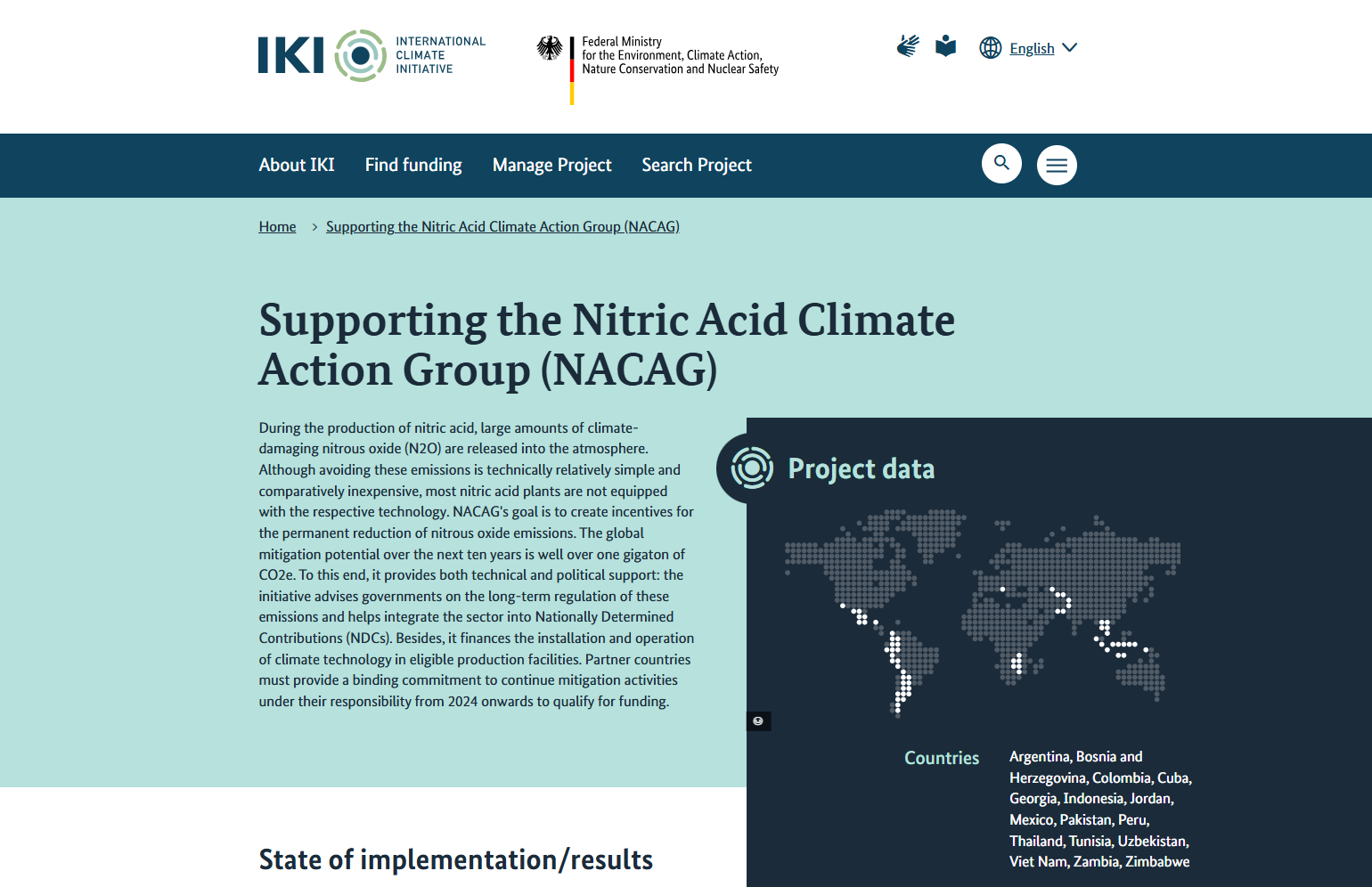
NACAG is a global initiative aimed at reducing nitrous oxide (N2O) emissions from nitric acid production. The initiative provides advice to governments and domestic producers on abatement technologies and public policies for regulating emissions in the sector. It also offers financial support for the purchase and installation of abatement technologies and N2O monitoring equipment. This support is available only to countries eligible to receive Official Development Assistance (ODA) that have joined the initiative.
Context
During COP21 in Paris in 2015, the German Federal Ministry for the Environment, Nature Conservation and Nuclear Safety (BMU) announced the creation of the Nitric Acid Climate Action Group (NACAG), with the aim of promoting the installation of technologies to reduce N2O emissions in the global nitric acid sector. In this context, NACAG seeks to mitigate N2O emissions generated by nitric acid production and incorporate these reductions into the fulfillment of the Nationally Determined Contributions of countries participating in the initiative.
The NACAG initiative is aligned with the framework of the Paris Agreement, as the German government provides climate finance while partner countries are encouraged to assume responsibility for reducing emissions in the future.
As a global action group, NACAG is open to all countries, whether as partner countries or donors.

Why the nitric acid sector?
Nitric acid is an important product for the chemical industry, as it is used to produce nitrogen-based fertilizers. However, its manufacturing process emits N2O, a potent greenhouse gas with a global warming potential 265 times greater than that of carbon dioxide (CO2).
Although emission abatement technologies are available at a comparatively low cost, the N2O generated during nitric acid production continues to be released into the atmosphere in most countries around the world. This is mainly because producers lack adequate incentives to invest in mitigation technologies, since these technologies do not provide a competitive advantage. This is compounded by the near-global absence of mechanisms regulating emissions in this sector.
Global nitric acid production is relatively centralized, with approximately 580 industrial plants producing 6.5 million tonnes of nitric acid annually. Most of these producers operate in developed countries that are not eligible to receive NACAG financing and where legislation regulating N2O emissions in the sector is already in place.
In this regard, reducing N2O emissions from nitric acid production will contribute to achieving the targets established under the Paris Agreement to keep the increase in global temperature below 2°C above pre-industrial levels. The nitric acid sector in developing countries is estimated to have a mitigation potential of approximately 200 million tonnes of CO2 equivalent.
Financing
NACAG provides financial support for reducing nitrous oxide emissions from nitric acid plants located in countries eligible for Official Development Assistance (ODA). Both existing N2O reduction projects and entirely new projects can be financed. NACAG provides financial support to individual nitric acid plant operators for their emission reduction activities, provided that the country where the plant is located is committed to maintaining emission reductions after 2020.
Two financing mechanisms are available. Mechanism I provides nitric acid plant operators with grants covering the investment, maintenance, and monitoring costs of abatement technology. Under Mechanism II, NACAG, in cooperation with the World Bank, offers to purchase emission credits generated by N2O reduction projects at prices determined through specially designed auctions.
Technical support
The NACAG Secretariat provides technical support to all stakeholders interested in participating in the reduction of nitrous oxide emissions from nitric acid production. The initiative provides plant operators with specific and tailored advice on the most appropriate abatement technology, its installation and operation, as well as the operational requirements for monitoring emission reductions.
In addition, the NACAG Secretariat advises governments on mechanisms for regulating nitrous oxide emissions. Under the Paris Agreement, all countries must formulate, submit, and periodically review their climate change mitigation activities and targets in the form of Nationally Determined Contributions (NDCs). NACAG aims for all countries to include nitrous oxide emission reductions in their NDCs and establish effective mechanisms to ensure long-term emission reductions.
How to join NACAG?
The initiative is open to all stakeholders, including governments, institutions, and private-sector representatives, that wish to support the goal of sustainably reducing nitrous oxide emissions from nitric acid production.
Governments are also invited to sign the Statement of Undertaking and thereby formally join NACAG. This document includes a commitment to permanently mitigate nitrous oxide emissions from nitric acid plants from 2021 onward.
Plant operators based in countries that have joined NACAG can apply for grants by completing and signing the grant application. If the application is successful, plant operators can receive technical advice and financial support to install and operate abatement technology.
For more information about NACAG, visit: http://www.nitricacidaction.org/