

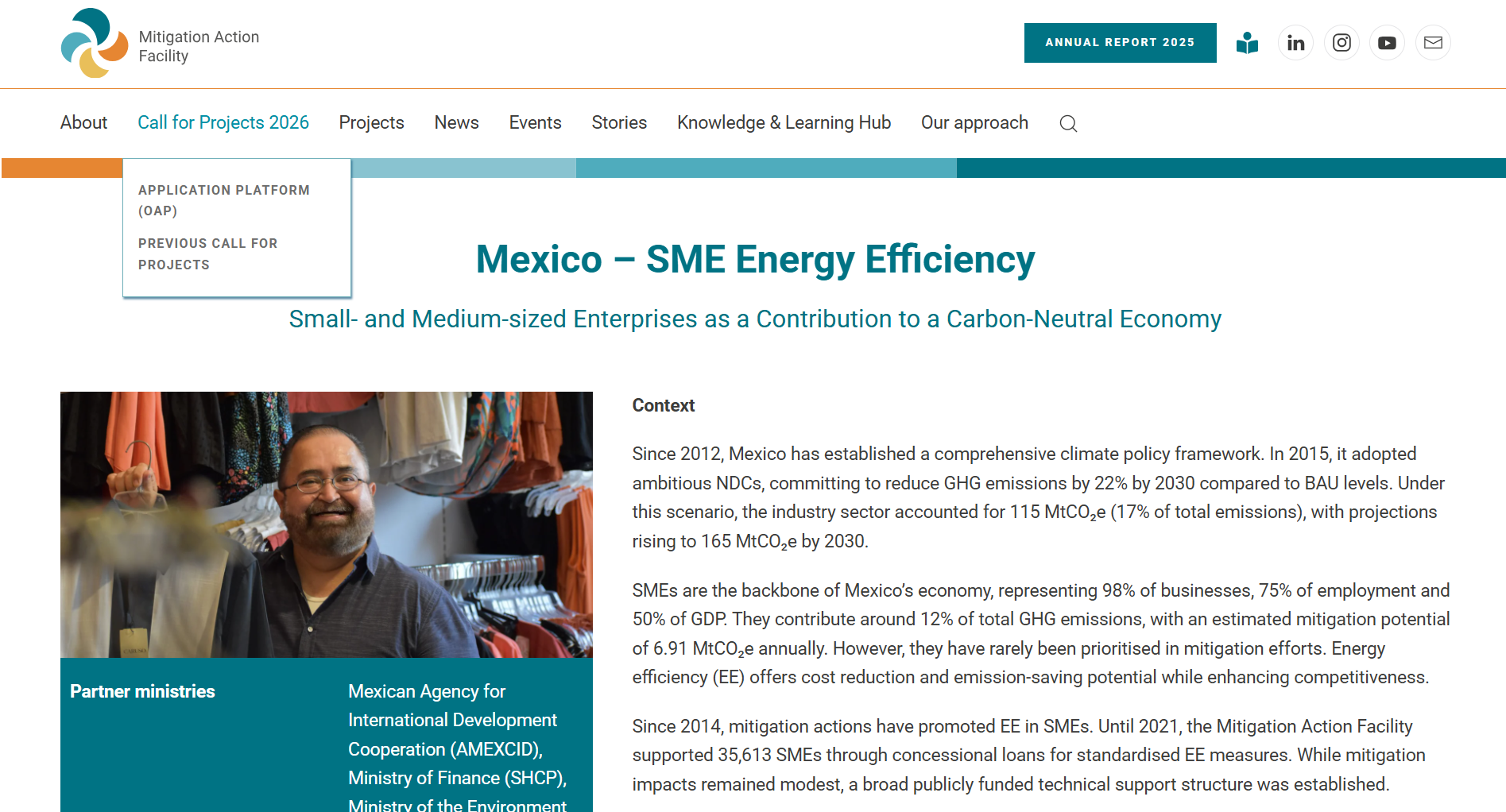
Since 2012, Mexico has established a comprehensive climate change policy framework, but despite many efforts, energy intensity has remained stable and emissions have continued to rise steadily. In November 2015, Mexico established ambitious INDCs, committing to reduce its greenhouse gas (GHG) emissions by 22% by 2030 compared with business-as-usual (BAU) levels.
Small and medium-sized enterprises (SMEs) are often described as the backbone of the Mexican economy, as they account for 98% of all businesses, 75% of employment, and generate 50% of the country’s GDP. They are responsible for approximately 12% of Mexico’s total GHG emissions, with a total emissions reduction potential of close to 6.91 MtCO2e per year. However, they are rarely recognized as an important target group by those promoting Mexico’s transition toward a low-carbon economy. Energy efficiency (EE) has been identified as a mechanism for reducing costs in SMEs and clearly demonstrates that companies can directly influence their energy costs by optimizing production processes, thereby increasing their competitiveness and reducing GHG emissions. However, to fully harness their mitigation potential, it is crucial that SMEs understand the potential and benefits of EE and are provided with appropriate mechanisms to ensure its maximization. Likewise, financial institutions, especially commercial banks, need to better understand the risk profile of SMEs and the technical aspects of clean technologies in order to manage their investment risk. This is key to leveraging more private capital for climate finance.

Recognizing the above, Mexico has already developed a NAMA to promote EE in SMEs. Implementation began in 2014, and so far it has provided publicly funded concessional loans to 17,501 companies for standardized EE measures, such as replacing obsolete equipment. However, given the basic technological approach adopted, it produced relatively modest impacts in terms of GHG emission reductions. Nevertheless, the initial NAMA successfully provided favorable loans to SMEs and created an extensive technical support structure financed 100% with public funds.
The proposed NAMA Support Project (NSP) will provide technical and financial assistance to the SME-NAMA mentioned above, significantly expanding its scope by launching a second phase of implementation. For this purpose, a strategy has been developed to provide financing for more complex EE measures, such as systems optimization in medium-sized enterprises (compressed air, steam generation and distribution, industrial refrigeration, among others), which will require higher investment costs but have greater energy-saving potential and therefore result in greater GHG reductions. In addition, by introducing commercial banks (second-tier institutions) as financial intermediaries, private capital will be leveraged to create significant opportunities for scaling up.

The NSP will focus on developing a dynamic and robust market for EE in SMEs, with a significant contribution from private capital and the potential for replication in other sectors. For this purpose, a new technological approach will be implemented, based on optimizing the performance of energy systems in selected SME subsectors, such as hotels, the chemical industry, and the food processing industry. In addition, a qualified supply of EE services provided by certified consulting firms will be established, and financial and market barriers will be addressed to attract commercial banks to participate in EE financing.
Direct leveraging of funds: Financial cooperation will be provided to establish a guarantee fund (€7 million), as well as a small-scale grant subsidy scheme (€2.5 million) to finance EE measures in SMEs. A leverage effect of at least €70 million in private capital for clean technology financing is expected.
Technical cooperation funds will be used to make awareness of the need for and importance of EE widespread among relevant stakeholders, and to generate a significant pipeline of bankable EE projects showcasing successful cases (€4 million). This will be achieved by providing the market with a qualified supply of EE services delivered by certified consulting firms and by raising awareness among SMEs of the economic and environmental benefits of EE, with particular emphasis on how it improves SME competitiveness.
Mitigation potential: Using a conservative approach, an energy efficiency project implemented in electrical and thermal energy consumption systems can generate average individual savings ranging from 40 to 100 tonnes of CO2e per year, which is 17 to 42 times higher than the savings achieved per project during the first phase of implementation. By the end of the fourth year of implementation, the NSP aims to have implemented a total of 9,000 projects with an annual impact capacity of 360,000 tonnes of CO2e per year. During the NSP implementation period, the estimated cumulative emissions reduction potential amounts to 421,200 tonnes of CO2e.