

Initial situation
In the 20th century, global raw material consumption increased almost twice as fast as the population and reached 84 billion tonnes in 2015, according to the International Resource Panel (IRP): biomass, fossil fuels, minerals, and non-metallic raw materials. It could reach 183 billion tonnes by 2050 if these trends continue. Because greenhouse gas emissions are closely correlated with energy and material flows, this scenario would also jeopardize international climate targets. An increasing share of global resource consumption is attributable to emerging economies, which often show high rates of economic growth while resource efficiency remains low.
The reasons include outdated and inefficient production technologies and the relocation of resource- and carbon-intensive industries to countries with low labor costs. This leads to increased GHG emissions, enormous pressure on natural resources, and reduced competitiveness. The main challenges facing emerging economies are a lack of awareness and insufficient individual and institutional capacities.

Brief description
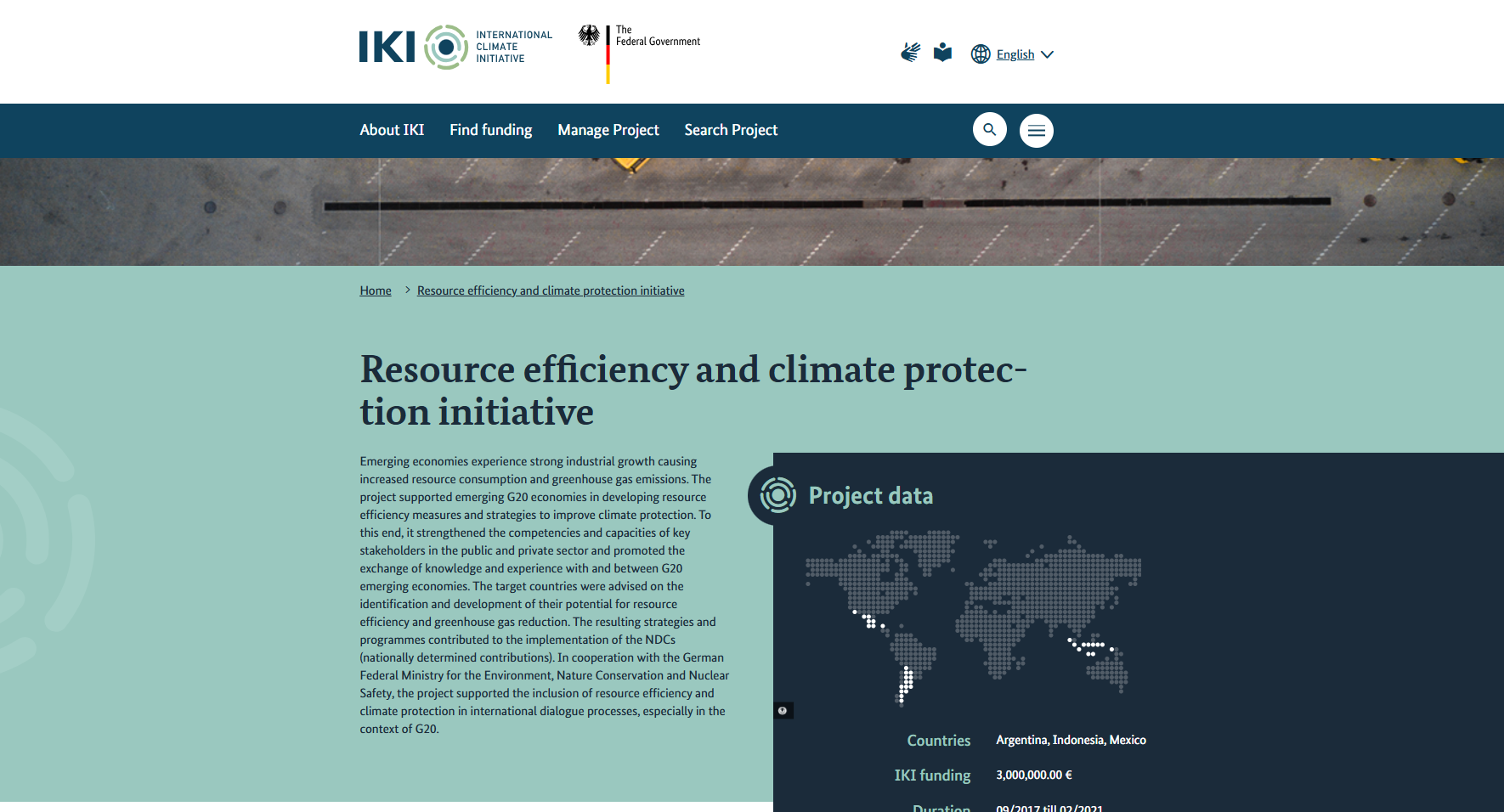
The project targets emerging economies, especially those of the G20, which show strong industrial growth and, closely linked to it, a marked increase in resource consumption and the associated greenhouse gas emissions. Its objective is to strengthen the capacities of key actors by enabling them to promote measures and strategies to increase resource efficiency and improve climate protection (Outcome). In close coordination with BMU, it supports the inclusion of resource efficiency and climate protection in international dialogues, particularly in the context of the G20. It promotes the exchange of knowledge and experience with and among emerging G20 countries and strengthens the capacities of key actors. On this basis, it provides demand-oriented advisory services to identify potential for improving resource efficiency and climate protection, as well as measures and strategies to harness this potential while taking Nationally Determined Contributions (NDCs) into account.
Argentina:
Together with the Ministry of Environment (SAyDS) and selected business associations—currently the Coordinator of Food Product Industries (COPAL) and the Argentine chapter of the WBCSD (CEADS)—awareness-raising events and expert discussions are organized for key actors from the policy, business, and academic sectors. With the support of international experts, pilot training courses are designed and delivered for the public sector (with SAyDS) and SMEs in the food industry (with COPAL). Existing experiences and successful practical examples for introducing resource-efficiency measures in companies are compiled, and their contribution to climate protection and the goals of the 2030 Agenda is analyzed (with SAyDS and CEADS). As part of an international study on the contribution of resource-efficiency measures in industrial value chains to climate protection, value chains in Argentina’s food industry are analyzed.
Indonesia:
With the support of international experts, pilot training courses will be developed and implemented for the public sector (with the Ministry of Industry (MoI)) and SMEs in the textile industry (with the Indonesian Cleaner Production Center (ICPC)). The Ministry of Industry (MoI) receives support in developing a green industry standard for resource efficiency through a pilot analysis to be carried out by an international expert. As part of an international study on the contribution of resource-efficiency measures in industrial value chains to climate protection, value chains in Indonesia’s textile industry are analyzed.
Mexico:
Partly together with the Ministry of Environment and Natural Resources (SEMARNAT), partly with associations and chambers from the business sector—the GEMI Initiative, the Mexican chapter of the WBCSD (CESPEDES), and the Business Coordinating Council (CCE)—or jointly with both, awareness-raising events and expert discussions are organized for key actors from the policy, business, and academic sectors. With the support of international experts, pilot training courses for SMEs are being developed and implemented in collaboration with the above-mentioned business associations and chambers. Together with CESPEDES, pilot examples of good practices for resource-efficiency measures in Mexican companies are prepared, and their contribution to climate protection is analyzed. Together with the Ministries of Environment and Economy of the State of Guanajuato and four industry associations, a short study analyzes the potential for efficient resource use and climate protection in selected economic sectors.
Multiplier effect
The project concept is based on cooperation with relevant networks, stakeholders, and international processes, for example in the context of the G7 and G20, which also serve as forums for replication. It creates or strengthens formats and a web-based platform for knowledge and experience exchange, as well as joint learning. In addition to best practices and learning experiences from emerging economies, especially those of the G20, instruments and examples from Germany on resource efficiency and climate protection—some of which have been supported by the national climate initiative—are shared and thereby replicated. This existing knowledge, as well as methods and approaches developed by international organizations such as UNEP and UNIDO, are also used and disseminated through training sessions, capacity-building courses, and demand-oriented country support. The experiences generated are presented and disseminated in international forums.